India on Monday expressed serious concerns over unilateral protectionist measures adopted by some WTO members in the guise of environmental protection and called for a permanent solution to the long-pending public stockholding (PSH) for food security, a crucial element for offering minimum support price (MSP) to its farmers and feed over 810 million poor.
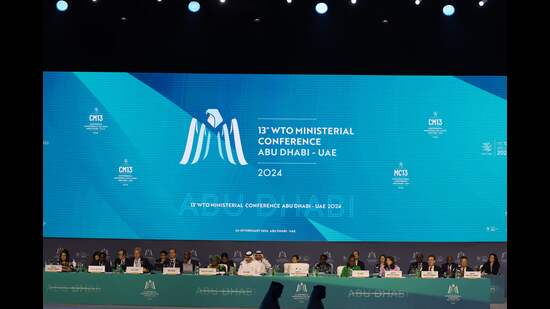
In the session on sustainable development and policy space for industrialisation, commerce secretary Sunil Barthwal said WTO members must avoid fragmentation of the multilateral trading system and should not mix non-trade issues with the WTO agenda.
The thirteenth ministerial conference (MC13) of the WTO began in Abu Dhabi on February 26. On the opening day, the Indian delegation was led by him. Replying to a specific question on absence of commerce minister Piyush Goyal at the conference in Abu Dhabi, WTO director-general Ngozi Okonjo-Iweala said while Indian delegation is participating in deliberation, Goyal is expected to join them soon.
In a recorded statement Goyal said a permanent solution on PSH is required to reduce global hunger by 2030. “Finding a permanent solution on PSH remains an unaccomplished agenda on which we have to deliver in MC13,” he said. Goyal said WTO should focus on trade issues and it should not negotiate on non-trade matters such as labour, gender and climate change.
India holds the view that these non-trade issues are important and they are deliberated at appropriate global forums with New Delhi taking a lead on almost all matters. Barthwal also expressed serious concerns regarding the increasing use of trade protectionist unilateral measures, which are sought to be justified in the guise of environmental protection. When non-trade related matters are force-fitted into the international trade rules architecture, the outcome is ham-handed justifications for trade distortive subsidies and erection of non-trade barriers, he said.
{{/usCountry}}India holds the view that these non-trade issues are important and they are deliberated at appropriate global forums with New Delhi taking a lead on almost all matters. Barthwal also expressed serious concerns regarding the increasing use of trade protectionist unilateral measures, which are sought to be justified in the guise of environmental protection. When non-trade related matters are force-fitted into the international trade rules architecture, the outcome is ham-handed justifications for trade distortive subsidies and erection of non-trade barriers, he said.
{{/usCountry}}India is committed to protect environment and it propagates a sustainable way of living based on traditions and values of conservation through a mass movement for LiFE -- Lifestyle for Environment to combat climate change.
Speaking at another session on ‘Trade and Inclusion’, Barthwal cautioned members that mixing non-trade topics with WTO rules can lead to greater trade fragmentation. Bringing issues like gender and micro, small and medium enterprises (MSMEs) in the realm of WTO discussions was not practical because these issues were being discussed in other relevant international organizations already, he said adding that India has already taken several concrete measures for MSMEs and women economic empowerment.
The first day of MC13 saw two countries – Comoros and Timor Leste -- acceded to the WTO, which made it a 166-member organisation, which will be completing its 30 years of its establishment next year.