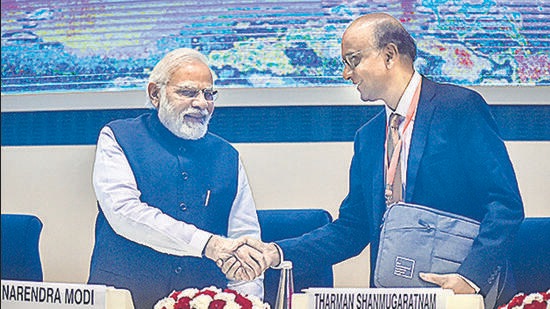
India, which will be taking over the G20 presidency next year, can provide global leadership and strengthen multilateral institutions, Singapore’s senior minister Tharman Shanmugaratnam said on Friday while delivering the keynote address at the first ‘Arun Jaitley Memorial Lecture’ (AJML) in New Delhi.
India is scheduled to hold the presidency of the G20 from December 1, 2022 to November 30, 2023, culminating with the G20 Summit in India next year. The G20 is one of the key international groups as its members represent more than 80% of the world’s gross domestic product (GDP), 75% of the global international trade and 60% of the world population.
Reflecting on recent geopolitical turmoil such as the Covid-19 pandemic, the Ukraine war and a spike in global inflation due to the disruption of supply chains and shortages of food and fuel, Shanmugaratnam said: “We have entered an era of profound fragility globally. In fact, a confluence of fragilities, a confluence of insecurities … existential economic and social at the same time.”
He also stressed on the urgency for a transition to low carbon pointed at the issues of environment and climate change. “The unpalatable reality is that we would have to rely more on fossil fuels to ensure energy security and to prevent sharply higher energy prices. But, it means that it’s all the more important that we double down on our medium to long term strategies of making a transition to a low carbon energy future,” he said.
{{/usCountry}}He also stressed on the urgency for a transition to low carbon pointed at the issues of environment and climate change. “The unpalatable reality is that we would have to rely more on fossil fuels to ensure energy security and to prevent sharply higher energy prices. But, it means that it’s all the more important that we double down on our medium to long term strategies of making a transition to a low carbon energy future,” he said.
{{/usCountry}}The minister was highlighting global issues that India could raise at the powerful G20. Leading economies are the members of the G20. They are Argentina, Australia, Brazil, Canada, China, France, Germany, India, Indonesia, Italy, Japan, Republic of Korea, Mexico, Russia, Saudi Arabia, South Africa, Turkey, the United Kingdom, the United States, and the European Union. Spain is also invited as a permanent guest.
Introducing Shanmugaratnam at the event where Prime Minister narendra Modi was also present, Union finance minister Nirmala Sitharaman recollected immense contributions of former finance minister Arun Jaitley in the Indian economy. The annual lecture, instituted in his memory, could not commence earlier in 2020 or in 2021 because of the pandemic, she said.
Addressing the gathering the Singapore’s minister said Jaitley was an “unusual combination of humility and self-belief” and recounted his major reforms such as implementation of Goods and Services Tax (GST).
Recollecting India’s recent achievements in inclusive growth such as providing toilet facilities, electricity connections and health and drinking water facilities to millions of its citizens, Shanmugaratnam said as India is celebrating 75th anniversary of its Independence and enters the as ‘Amrit Kaal’ when India will attain 100 years of Independence, it has also to be prepared for emerging challenges such as providing jobs to aspiring youth.
India will require to achieve higher economic growth by focusing manufacturing, exports and expanding its production-linked incentive (PLI) scheme for more sectors that could create jobs, he said. “India needs much higher growth and much deeper inclusivity,” he said.
In order to achieve India’s economic or social ambitions in the next 25 years the country needs “substantially higher growth”, he said adding that India must grow by at least 8 to 10% annual over the next 25 years. He said higher economic growth is needed to raise average incomes and create jobs for India’s large young population.
The PLI scheme is working well and it has to be expanded with a special focus on labour intensive industries, he said.
“Agriculture is critical,” he said adding that the sector can provide quality jobs to the youth provided the government undertakes throurough farm-sector reforms. He also highlighted immense untapped opportunities in India’s tourism sector. “So remarkable country to visit for people from anywhere in the world. I mean, that’s true attractions like Kaziranga in Assam…” he said citing names of some of the key tourists destinations.
Later, moderating a panel discussion on the theme -- ‘Growth through Inclusivity, Inclusivity through Growth’ -- Institute of Economic Growth (IEG) President NK Singh said that India converted “great challenge of the pandemic into a historic opportunity” to take forward its entire reform strategy.
During the panel discussion, the panellists sounded optimistic about the global economy and international trade despite geopolitical disruptions.
“Increase risk always requires diversification and so today lot of the multinationals are looking for diversification to other countries,” said Columbia University professor Arvind Panagariya, who was the first vice-chairman of the NITI Aayog.
Participating in the panel discussion, Organisation for Economic Cooperation and Development (OECD) secretary-general Mathias Cormann said, “While the global rules based trading system has for some time been under pressure, and some of these pressures have come to the fore in the context of the pandemic and also more recently in the context of the war in Ukraine with supply chain challenges and so on. I mean, overall our global markets continue to perform very well… I mean the global trade is growing…” He also said the OECD learnt immensely from Jaitley’s tax reforms such as subsuming several state and local levies into a uniform Goods and Services Tax (GST).