Indian and Chinese soldiers on Monday disengaged from Patrol Point-15 in the Gogra-Hot Springs area of eastern Ladakh, with the process involving front-line troops moving back to rear locations, dismantling of temporary infrastructure created there and joint verification to assess the full implementation of the disengagement to follow, officials familiar with the matter said.
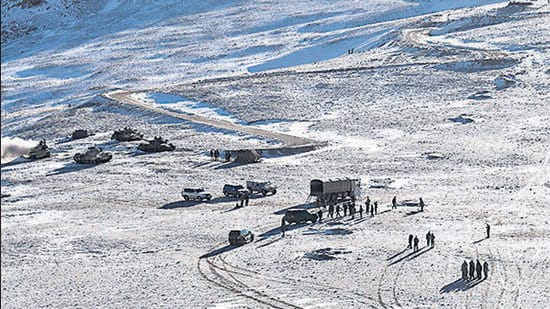
This is the fourth round of disengagement between the Indian Army and Chinese People’s Liberation Army (PLA) after the border row erupted in May 2020, and its completion has now turned the spotlight on frictions areas that are still unresolved along the Line of Actual Control (LAC) – Depsang and Demchok, said one of the officials cited above asking not to be named.
The disengagement at PP-15, announced jointly by India and China last week, is likely to result in the creation of a buffer zone of 2 to 4 km, as was done after the previous rounds of troop pullback from friction points, though there was no official word from the government on the latest pullback.
The process was completed in five days --- India and China had on September 8 announced that their front-line troops had kicked off disengagement from PP-15, with the breakthrough coming after the 16th round of military talks in July.
“Talks appear to be moving in the right direction. We should continue the negotiations at the political, diplomatic and military levels to sort out the outstanding problems in the other two remaining areas. Also, we should not expect results after every round of talks,” said former director general of military operations Lieutenant General Vinod Bhatia (retd).
{{/usCountry}}“Talks appear to be moving in the right direction. We should continue the negotiations at the political, diplomatic and military levels to sort out the outstanding problems in the other two remaining areas. Also, we should not expect results after every round of talks,” said former director general of military operations Lieutenant General Vinod Bhatia (retd).
{{/usCountry}}Despite 16 rounds of military talks held so far, problems at Depsang in Daulet Beg Oldi sector and Charding Nullah Junction (CNJ) in the Demchok area are still on the negotiating table.
India and China have been locked in a border standoff for 28 months, and talks have led to disengagement at four friction points along LAC so far, with resolution of outstanding problems at two friction areas still elusive. Despite the disengagement goals achieved thus far, both sides remain heavily deployed in the Ladakh theatre.
Disengagement of Indian and Chinese soldiers from friction points on LAC in the Ladakh sector had been stuck for over a year , with the last breakthrough before the PP-15 development coming in August 2021 when the two armies pulled back their forward deployed troops from the Gogra sector (PP-17A).
The two sides withdrew their soldiers from the Gogra sector, which was one of the friction points on LAC, to their permanent bases on August 4-5 after the 12th round of military talks held between Indian and Chinese corps commander-rank officers on July 31, 2021.
The two armies held eight rounds of talks in 2020 with the first held in June of that year, five rounds in 2021, and have held three rounds of talks so far this year.
Despite four rounds of disengagement from Galwan Valley, Pangong Tso, Gogra (PP-17A) and now PP-15, the two armies still have around 60,000 troops each and advanced weaponry deployed in the Ladakh theatre.