E-Paper



India doesn’t have ‘blanket arrangement’ with Iran for Hormuz transit: Jaishankar
In an interview with Financial Times, Jaishankar said talks with Iran on the safe passage of Indian vessels through the crucial waterway were “ongoing”.

 Prefer HTon Google


India does not have a “blanket arrangement” with Iran for Indian-flagged ships to transit the Strait of Hormuz, and “every ship movement is an individual happening”, external affairs minister S Jaishankar has said.
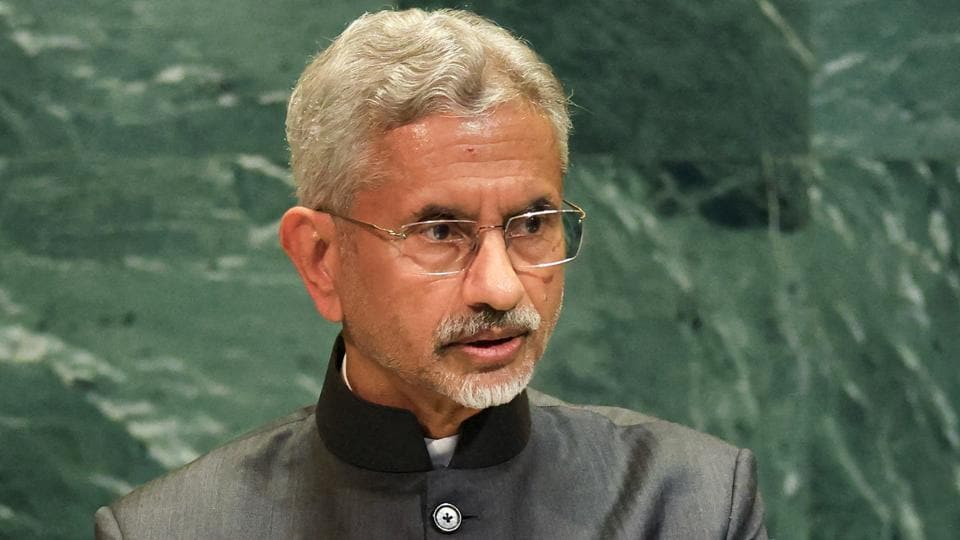
In an interview with Financial Times in Brussels on Sunday, Jaishankar said talks with Iran on the safe passage of Indian vessels through the crucial waterway were “ongoing” and “yielding results”. He cited the negotiations, which have resulted in two Indian-flagged gas tankers passing through the strait on Saturday, as an example of what diplomacy could bring.
“I am at the moment engaged in talking to them, and my talking has yielded some results,” he said. “This is ongoing. If it is yielding results for me, I would naturally continue to look at it.”
Jaishankar added there was no “blanket arrangement” with Iran for Indian-flagged ships to transit the strait, and that “every ship movement is an individual happening”. He denied that Iran had received anything in exchange, and cited a “history of dealing with each other... which is the basis on which I engaged”.
“It’s not an exchange issue,” he said.
“India and Iran have a relationship. And this is a conflict that we regard as something very unfortunate,” Jaishankar said. “These are still early days. We have many more ships there. So while this is a welcome development, there is continuing conversation because there is continued work on that.”
Jaishankar’s comments came in the wake of US President Donald Trump’s demand that other countries, such as China, France, and the UK, should send warships to help the US force open the critical waterway, even as energy prices surged after Iran effectively closed the Strait of Hormuz.
Two Indian-flagged LPG carriers, Shivalik and Nanda Devi, are on their way to Indian ports with 92,712 metric tonnes of LPG after crossing the Strait of Hormuz on Saturday. They are scheduled to reach Mundra port on March 16 and Kandla port on March 17, respectively. Indian officials have said another 22 Indian-flagged vessels are still located to the west of the strait.
The two LPG carriers transited the strait soon after phone calls between Prime Minister Narendra Modi and Iranian President Masoud Pezeshkian and foreign ministers Jaishankar and Seyed Abbas Araghchi.
Araghchi called for Brics, currently led by India, to play a constructive role in supporting security and stability in the region. The Indian side subsequently said that New Delhi’s efforts to forge a consensus on a common Brics position on the conflict had been “obviously impacted” as some members of the grouping were “directly involved” in the situation.
Jaishankar, who is in Brussels to attend a meeting of European Union (EU) foreign ministers, said that, from India’s perspective, it is “better that we reason and we coordinate, and we get a solution than we don’t”. He added: “So if that sort of allows other people to engage, I think the world is better off for it.”
When he was asked if European countries could follow India’s arrangement with Iran, he replied: “Each relationship, frankly, in a way stands on its own merits…So now, it’s very hard for me to compare this with some other relationship which may or may not have these.”
Also Read: 19 Indians arrested in UAE for posting ‘misleading content’ online amid US-Iran war
He added, “I’d be happy to share with [EU capitals] what we are doing…I know many of them have had conversations [with Tehran] as well.”
Oil prices closed above $100 last week for the first time since August 2022, with analysts expecting prices to keep rising as the conflict drags on. Iran’s new Supreme Leader, Mojtaba Khamenei, has said they will continue blocking the narrow strait, through which almost a fifth of the world’s oil and gas used to transit. France and Italy are among the countries that have opened talks with Iran about a possible diplomatic solution to allow for energy shipments.