India’s public spending on education has increased over the years, but remains below those of some other Brics countries, according to the Brics Joint Statistical Publication 2026, released last month.
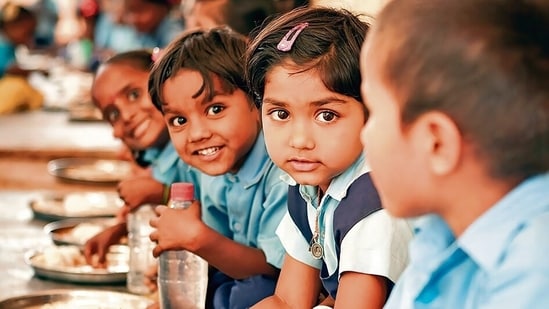
According to the report, India’s household spending on education also increased. In urban India, education accounted for 4.3% of household expenditure in 2000, rising to 6% in 2025 (Shutterstock)
{{^htLoading}} {{/htLoading}}
India also continues to face the challenge of converting educational investment into a workforce employed in higher-productivity sectors, amid the need for greater “alignment of training programmes with evolving market demands” and stronger “linkage of Technical and Vocational Education and Training (TVET) institutions with industries” according to Brics Education Ministers’ Declaration adopted at the 13th Brics Education Ministers’ Meeting in Bhubaneswar on August 7, 2026.
India’s public expenditure on education increased from 1.2% of GDP in 2016 to 4.1% of GDP in 2023. This compared with 4.9% in Brazil and 10.5% in South Africa, while it was marginally higher than China’s 4.02%, Russia’s (3.5%), the UAE’s (3.8%) and Indonesia’s (1.3%), according to the report. To be sure, China’s GDP is much higher than India’s, and its population older (a median age of 41 compared with India’s 29 years, according to the UN’s World Population data).
According to the report, India’s household spending on education also increased. In urban India, education accounted for 4.3% of household expenditure in 2000, rising to 6% in 2025 — an increase of 1.7 percentage points. In rural areas, the share rose from 1.9% to 3.2%, an increase of 1.3 percentage points. By comparison, Indonesia’s education spending accounted for 3.7% of urban household expenditure and 2.1% of rural expenditure in 2025. In China, the broader category of ‘Education, cultural and recreation’ accounted for 12.0% of urban household consumption and 11.5% of rural household consumption in 2025.
{{^htLoading}} {{/htLoading}}
Yet India’s employment structure remains heavily dependent on agriculture and allied activities. In 2025, 43% of India’s employed population was in the primary industry, compared with 29.3% in Indonesia, 22.2% in China, 8% in South Africa and 5.3% in Russia. India’s primary-sector share has fallen only 1.6 percentage points from 44.6% in 2018. Industry accounted for 25.1% and services 31.9% of employment in India, the report said.
Sanjay Maurya is a Principal Correspondent with Hindustan Times, where he covers education, with a focus on school and higher education, competitive examinations, education policy and governance. Working as part of the National Bureau, he is based in New Delhi and reports on the Ministry of Education and covers various statutory bodies like UGC, AICTE and NCTE and autonomous bodies like CBSE and NCERT. His reporting also tracks the implementation of key government reforms and policies from school education to higher education including in IITs, NITs, IIMs, central and state universities, and their impact on students and educational institutions. His reporting on the irregularities and rushed implementation of CBSE's On-Screen Marking (OSM) system for evaluation of Class 12 board exams 2026, triggered administrative action, leading to the transfer of the board's two senior-most officials and the constitution of a committee to probe alleged irregularities in procurement process of the system. He joined Hindustan Times in December 2024. Prior to that, he had a three-year stint at Careers360, where he reported on school and higher education, entrance examinations, admissions, rankings and various education policies involving universities and professional education bodies. Over the years, Maurya has reported extensively on major developments in India's education sector, including the implementation of the National Education Policy (NEP) 2020, reforms in the National Testing Agency (NTA) following the NEET-UG 2024 controversy, changes in school education, higher education regulation, and the evolution of entrance examinations such as NEET, JEE and CUET. He regularly produces data-driven and explanatory stories based on government documents, parliamentary proceedings, court records and official data. His focus remains on helping readers understand how education policies and institutional decisions affect millions of students, teachers and educational institutions across the country.
Get the latest India News, breaking headlines and real-time updates from across the country. Stay informed about politics, government policies, crime, weather major national developments and Karnataka Bandh LIVE.
Home/India News/India’s education spending rises, still lags some BRICS nations
{{^htLoading}}
Advertisement
{{/htLoading}}
SHARE THIS ARTICLE ON
{{#usCountry}}{{/usCountry}}
Notifications
Get breaking alerts directly from the newsroom
Notifications are on!You'll be notified when news breaks