New Delhi: India has reached out to the military leadership of Bangladesh led by Army Chief General Waker-us-Zaman and asked for early restoration of peace, law and order and normalcy in the strife hit country.
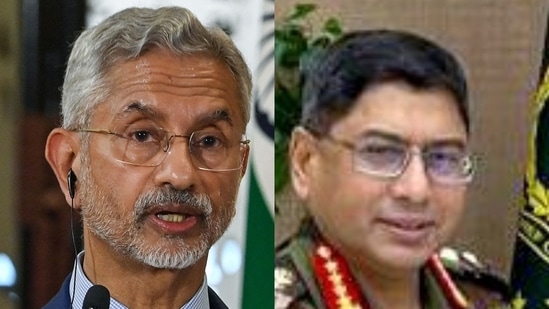
According to top government sources, the Modi government has already reached out to Army Chief and has extended any support to restoration of normalcy in the country after ouster of Sheikh Hasina on Monday.
It is understood that ousted Bangladesh PM Sheikh Hasina is being treated as the guest of the country and it is for her to decide her future stay.
S Jaishankar at all-party meeting
In the all party meeting, External Affairs Minister S Jaishankar when asked by Opposition on whether Pakistan had any role to play in the ouster of Hasina, pointed to the displayed pictures of Bangladesh Opposition on social media accounts of Pakistani diplomats. He apparently said that the role of Pakistan interference was still being examined.
After the ouster of Sheikh Hasina, the Narendra Modi government has assessed the fall-out of the coup in Bangladesh and is formulating strategies to ensure that normalcy is restored in Dhaka through dialogue with the protesting youth.
{{/usCountry}}After the ouster of Sheikh Hasina, the Narendra Modi government has assessed the fall-out of the coup in Bangladesh and is formulating strategies to ensure that normalcy is restored in Dhaka through dialogue with the protesting youth.
{{/usCountry}}Incidentally, Sheikh Hasina had already indicated to her Indian interlocutors that she did not want to fight the January 2024 general elections way back in April 2023 and only after persuasion from her supporters she reluctantly went into the electoral ring.
Knowing fully well the threat she was facing from Islamists as well as regime change agents of the west, Hasina did not want any one in her family to succeed her as she knew that they would be killed by her opponents. In that way, Hasina was a formidable wall against Islamists that fell down due to machinations of protestors on Monday.
While Hasina is still to recover from her shocking exit from Dhaka, the Modi government will not let down India’s friend in the neighborhood and will leave the decision of political asylum in a third country to the ousted PM.
Even though the Army and euphoric radicals are celebrating the exit of Sheikh Hasina, Bangladesh itself is on the verge of economic crisis like Pakistan, Maldives and Sri Lanka and will need support of western backed financial institutions to survive. Given the rate of unemployment, the radical students owing affiliation to Jamaat e Islami may turn against the Army if the solution offered is not to their liking.
Sheikh Hasina’s exit has left India between a rock and a hard place as a radical regime will pose a threat from the eastern front with New Delhi now facing an increasingly unstable neighborhood. While the Modi government will offer its support to stabilize the interim government in Bangladesh, anti-Sheikh Hasina supporters in the west will set their own anti-India play into motion. Barring Bhutan, all India’s neighbors are currently facing political turmoil and the situation is expected to get worse in future. The only option that India has is to insulate itself from cross border challenges through better security and advance intelligence apart from tackling the fifth columnists within.