India on Tuesday called for “mutuality of interest and reciprocity” in relations with Bangladesh in response to Dhaka setting the extradition of former premier Sheikh Hasina and other fugitives as a condition for a possible bilateral visit by Prime Minister Tarique Rahman.
The development comes at a time when the prospect of a visit by Rahman remains shrouded in uncertainty, with Dhaka giving no indication till Tuesday on whether he will take up New Delhi’s invitation. This is the first time that India has invoked the principle of reciprocity for ties with Bangladesh, and it came two days after Dhaka reiterated its demand for Hasina’s extradition.
Also Read | Bangladesh sets Sheikh Hasina's extradition as condition for PM Tarique Rahman’s India visit
Extradition of Sheikh Hasina
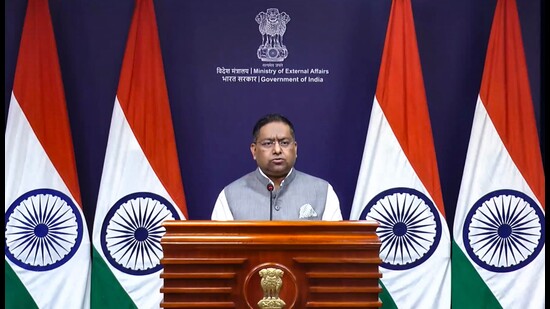
External affairs ministry spokesperson Randhir Jaiswal outlined India’s position on the matter at a regular media briefing in response to a question from HT on the Bangladesh foreign ministry’s strongly worded statement on Sunday calling for the extradition of Hasina, other fugitive criminals and the suspected killers of Bangladeshi politician Sharif Osman Hadi arrested in West Bengal.
“On your question on the remarks by the Bangladesh foreign office, let me say that India desires positive, constructive and forward-looking relations with Bangladesh, based on mutuality of interest and reciprocity,” Jaiswal said.
{{/usCountry}}“On your question on the remarks by the Bangladesh foreign office, let me say that India desires positive, constructive and forward-looking relations with Bangladesh, based on mutuality of interest and reciprocity,” Jaiswal said.
{{/usCountry}}He reiterated the Indian side’s position of distancing itself from the virtual news conference organised by Hasina on August 5 — a development that Bangladesh contended had vitiated the process for organising Rahman’s visit.
Also Read | Bangladesh turns to India for help as power crisis forces 8pm shutdown for malls, shops
“On the issue of extraditions, our consistent position has been…that these requests are being examined as part of our established processes,” Jaiswal said, reiterating New Delhi’s position that it is looking into Dhaka’s requests to extradite Hasina and the others.
Jaiswal’s remarks were also seen as a response to the statement by the foreign ministry in Dhaka on Sunday on pursuing a “Bangladesh First” policy for relations with other countries based on “sovereign equality, national dignity, non-interference in each other’s internal affairs and mutual benefit”. The statement made it clear that a “propitious environment” could be created for Rahman’s visit through action on the request to extradite Hasina.
Tarique Rahman's visit
People familiar with the matter on both sides indicated that a visit by Rahman at the current juncture is unlikely. Rahman is also not expected to attend the Brics Summit being hosted by India in September — to which he has been invited in his capacity as chair of the Bimstec grouping — and Bangladesh is likely to be represented by another leader or official, they said.
Bangladesh seeks additional fuel supplies from India
Jaiswal responded to a separate question on Bangladesh seeking additional fuel supplies from India to tide over an energy crisis by saying that the matter is being looked at by the Indian side. “We have ongoing energy cooperation with Bangladesh. As far as the additional request is concerned, we are examining this given our own requirements, our refining capacity, as also the availability [of fuel] on our side,” he said.
Also Read | Bangladesh urges faster extradition of Hasina as Indian envoy meets PM Tarique
With a recent report by a UN Security Council body pointing to al-Qaeda in the Indian Subcontinent (AQIS) attempting to set up cells in Bangladesh, Jaiswal said terrorism and security matters are a “common scourge”. He added, “We want to fight this problem together.”
Jaiswal responded to yet another question regarding the possibility of India and Bangladesh working together on sharing the waters of the Teesta — the only one of 54 shared rivers for which the two sides have not reached an agreement — by saying all water-related collaborations and discussions are handled by the bilateral Joint Rivers Commission and other structured dialogue mechanisms.