New Delhi: India and Japan on Saturday expressed serious concern about the war and humanitarian crisis in Ukraine, and sought an immediate end to violence and a return to the path of dialogue and diplomacy to resolve the conflict.
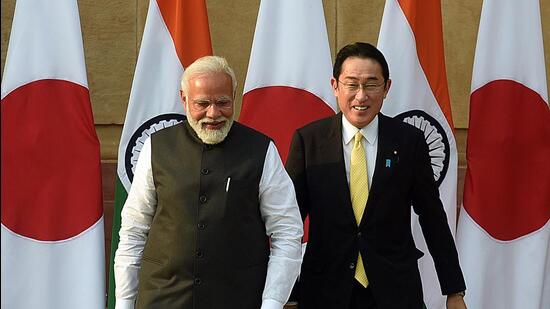
The two sides outlined their position on the Ukraine crisis in a joint statement issued at the conclusion of an annual summit between Prime Minister Narendra Modi and his Japanese counterpart Fumio Kishida. The statement said the two leaders will take “appropriate steps to address the humanitarian crisis in Ukraine”.
As a close strategic partner of Russia, India has so far refrained from criticising President Vladimir Putin’s invasion of Ukraine and has called for respecting the sovereignty and territorial integrity of all states. India has also abstained on resolutions at UN agencies that were critical of Russia while Modi has made several calls for an immediate cessation of violence.
On the other hand, Japan has joined the US and its allies in condemning Russia’s actions and imposing strong sanctions against Russian individuals and entities, including state-owned arms exporter Rosoboronexport and several banks. Japan has also provided non-lethal military equipment to Ukraine.
The joint statement said the prime ministers “expressed their serious concern about the ongoing conflict and humanitarian crisis in Ukraine and assessed its broader implications, particularly to the Indo-Pacific region”. They emphasised that the contemporary global order was built on the UN Charter, international law and respect for sovereignty and territorial integrity of states.
{{/usCountry}}The joint statement said the prime ministers “expressed their serious concern about the ongoing conflict and humanitarian crisis in Ukraine and assessed its broader implications, particularly to the Indo-Pacific region”. They emphasised that the contemporary global order was built on the UN Charter, international law and respect for sovereignty and territorial integrity of states.
{{/usCountry}}“They underscored the importance of safety and security of nuclear facilities in Ukraine and acknowledged active efforts of the IAEA towards it. They reiterated their call for an immediate cessation of violence and noted that there was no other choice but the path of dialogue and diplomacy for resolution of the conflict,” the joint statement said.
At a joint media interaction after the summit, Modi did not make any direct reference to the Ukraine crisis but noted that “geo-political events” were presenting new challenges. Kishida was more pointed in his remarks – he said the “Russian attack on Ukraine is a serious development that has shaken the roots of the international order”.
Kishida said he had told Modi that unilateral efforts to change the status quo by force cannot be allowed in any region. Japan and India will call for a ceasefire and efforts to end the conflict through talks, he said.
Both leaders agreed on the need to find a peaceful solution to all conflicts on the basis of international law, and the two countries will increase their efforts to ensure a free and open Indo-Pacific, the Japanese PM said. He also called for efforts to forge a new world order, including reforms of the United Nations Security Council and the elimination of nuclear weapons.
Foreign secretary Harsh Shringla told a media briefing that Modi and Kishida had exchanged views on regional and global issues, including Ukraine, during their one-on-one and delegation level talks. “Obviously, this issue is an important issue at a global level, it is an issue which is important for both our countries as well,” he said.
Noting that the Ukraine issue also figured at a recent virtual summit of Quad leaders, Shringla said those discussions were useful in converging various viewpoints. There was a similarity of viewpoints between India and Japan and that convergence had continued at Saturday’s summit, he said.
Shringla noted that while Japan had allocated $100 million for providing humanitarian assistance to Ukraine, India had supplied 90 tonnes of aid, including medicines and blankets, for the people displaced by the conflict.