India’s Moon mission Chandrayaan-3, in a giant leap for its space programme, successfully touched down on the lunar south pole at 6.04pm on Wednesday, propelling the country to an exclusive club of four and making it the first country to land on the uncharted surface. India scripted history as Indian Space Research Organisation or ISRO's ambitious third Moon mission touched down on the surface.
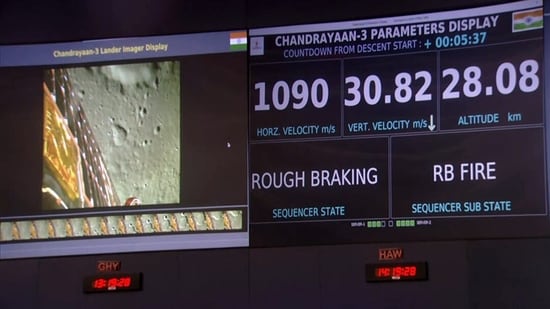
In a big boost to India's space prowess, the LM comprising the lander (Vikram) and the 26 kg rover (Pragyan), made the soft landing near the south polar region of the Moon at 6.04 pm, less than a week after a similar Russian lander Luna-25 crashed.
Chandrayaan-3 is a follow-on mission to Chandrayaan-2 and its objectives are to demonstrate a safe and soft landing on the lunar surface, roving on the Moon, and to conduct in-situ scientific experiments.
What went wrong with Chandrayaan-2?
Chandrayaan-2 had failed in its lunar phase when its lander 'Vikram' crashed into the surface of the Moon minutes before the touch down following anomalies in the braking system in the lander while attempting a landing on September 7, 2019, according to ISRO chairman S Somanath. Chandrayaan's maiden mission was in 2008.
Somanath also revealed that the lander's five engines, used for reducing velocity in a process called retardation, produced more thrust than expected. This led to an accumulation of errors, causing the craft to make rapid turns to correct its course.
{{/usCountry}}Somanath also revealed that the lander's five engines, used for reducing velocity in a process called retardation, produced more thrust than expected. This led to an accumulation of errors, causing the craft to make rapid turns to correct its course.
{{/usCountry}}However, the software limited the spacecraft's ability to turn, leading to a high-velocity landing in a specific 500x500 square meter area, which in itself is a very small region for a spacecraft to attempt to land. Somanath said that the main issue with Chandrayaan-2 was its limited ability to handle parameter variation and dispersion.
The ISRO’s ₹978 crore unmanned mission failed its objective after the lander ceased communication to the ground stations at an altitude of 2.1 km from the surface of the Moon. Soft landings, described by former ISRO chairman K Sivan, are “15 minutes of terror” which present a challenge due to the precise timing required for the rocket engine to fire. The firing attempts to “lower the lander carrying the rover down on the Moon, which has no atmosphere". This is why only 37% soft landings so far have been successful.
How is Chandrayaan-3 different?
The Chandrayaan-3 mission was launched on July 14 from Sriharikota in Andhra Pradesh. The ISRO has included a "failure-based design" in Chandrayaan-3, unlike the “success-based design” used in Chandrayaan-2. This new approach focuses on potential failure scenarios and how to protect against them to ensure a successful landing.
Since its launch, it has looped through progressively wider-ranging orbits of Earth, transferred to a lunar orbit and emerged as a focus of national pride and global interest after Russia's failed attempt to beat it to a landing on the Moon's south pole.
"The velocity at the start of the landing process is almost 1.68 km per second, but this speed is horizontal to the surface of the moon. The Chandrayaan-3 here is tilted almost 90 degrees, it has to become vertical. So, this whole process of turning from horizontal to vertical is a very interesting calculation mathematically. We have done a lot of simulations. It is here where we had the problem last time (Chandrayaan-2)," Somanath explained.
The significance of the Chandrayaan-3 mission, unlike its unsuccessful predecessor, is that the Propulsion Module has a payload -- SHAPE -- Spectro- polarimetry of HAbitable Planet Earth which is to study Earth from lunar orbit.
The ISRO said the SHAPE is an experimental payload to study the spectro-polarimetric signatures of the Earth in the near-infrared wavelength range.
Why is it so difficult to land on the Moon?
Compared to the Earth, Moon’s reduced gravity, very little atmosphere and lots of dust pose difficulties in landing. The lunar south pole is an area of interest for humans due to the presence of water molecules. However, the surface also has hazards like rocks and craters, which can make it difficult to identify safe landing sites within shadowed and dark surface regions.