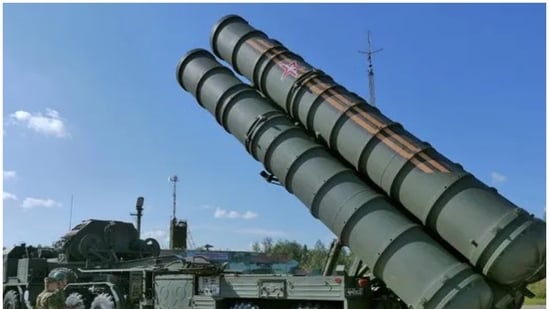
India moves to buy 5 more S-400s after Op Sindoor success; Russia sends cost proposal
The decision for approval will be taken by the Cabinet Committee on Security after the cost is finalised and a green signal obtained from the finance ministry.
India’s decision to acquire five more S-400 Triumf air defence systems from Russia has gained further momentum with Moscow sending in Bill of Quantities (BOQ) proposal, which details the cost of construction and materials, to Delhi for the cost negotiations to begin.
The decision to approve five more squadrons of S-400 air defence system will be taken by the Cabinet Committee on Security after the cost is finalized with Moscow.
{{^htLoading}} {{/htLoading}}
The last of the five S-400 system contracted by the Narendra Modi government in 2018 at a cost of USD 5.43 billion will be reaching India in November this year.
Contrary to what a section of the media is reporting, India has taken no decision on the acquisition of two squadrons of fifth generation SU-57 fighter aircraft from Russia, but the Indian Air Force has shown interest in Moscow’s proposal as Chinese fifth generation fighter J-20 has been deployed by the Xi Jinping regime in Hotan, Lhasa and Nyinchi airbases in Tibet under the PLA’s western theatre command.
According to authoritative sources, the decision to approve five more squadrons of S-400 air defence system will be taken by the Cabinet Committee on Security after the cost is finalised with Moscow and a green signal obtained from the Indian finance ministry. The fifth S-400 system will be deployed in India’s eastern sector facing China.
During Operation Sindoor in May 2025, the S-400 system came out in flying colours with one of its long range missile targeting a Pakistan early airborne warning aircraft at a distance of 314 kilometers across the Indus in Pakistani heartland. While the Pakistanis used kamikaze drones to target the S-400 systems deployed in Adampur and Bhuj air bases, the Russian surface to air missile system ensured that none of the Pakistani fighters could come anywhere near the Indian border for the fear of being knocked down from the skies.
{{^htLoading}} {{/htLoading}}
In fact, on May 10, the Pakistani air force moved all its air assets to bases near Durand Line with Afghanistan as 11 of their air bases were hit by Indian BrahMos missiles and as many as seven fighters were knocked down by Indian S-400 and Akash Tir air defence systems.
With Russian President Vladimir Putin expected to be in Delhi for BRICS summit on September 11-13, the Indian defence cooperation with Russia will be further cemented in the hypersonic missile sector.
Shishir Gupta is Executive Editor at Hindustan Times and one of India's top journalists covering national security, strategic affairs, foreign policy and geopolitics. Over the past three decades, he has extensively reported on India's military, diplomatic and security landscape, covering every major conflict and national security challenge, from the 1999 Kargil War and the 2020 East Ladakh standoff to Operation Sindoor in 2025. He has also covered major terror attacks, including the IC-814 hijacking, the 26/11 Mumbai attacks and the 2025 Pahalgam terror strike, along with numerous Pakistan-backed terrorist incidents in the Kashmir Valley and across India. He has reported on national and state elections for more than three decades. A recognised authority on strategic affairs, Gupta has covered India's nuclear programme since the Pokhran-II (Shakti series) tests in May 1998 and has written extensively on global nuclear issues, Indian diplomacy and the country's expanding global outreach. He has also reported widely on international conflicts and terrorism, with a special focus on the Indian subcontinent. Gupta has interviewed Prime Minister Narendra Modi more than four times, including Modi's first interview with the print media after becoming Prime Minister in May 2014. His other interviews include three with the Dalai Lama, as well as conversations with Benjamin Netanyahu, Amit Shah, Yogi Adityanath, S. Jaishankar, Nirmala Sitharaman and Piyush Goyal. He is the author of Indian Mujahideen: The Enemy Within (Hachette, 2011) and Himalayan Face-off: Chinese Assertion and Indian Riposte (Hachette, 2014). He was awarded the Chevening-Wolfson Joint Scholarship at Wolfson College, University of Cambridge, UK, in 1998 and participated in the International Visitor Leadership Program (IVLP) of the US State Department in 2006. He received the Ben Gurion Prize from Israel in 2011 and the K. Subrahmanyam Prize for Strategic Studies in 2015 from the Manohar Parrikar Institute for Defence Studies and Analyses (MP-IDSA). Since 2024, he has hosted Point Blank, Hindustan Times' weekly YouTube show on global geopolitics.
Get the latest India News, breaking headlines, and real-time updates from across the nation. Stay informed on politics, government policies, crime, weather, and major developments on Hindustan Times
Get the latest India News, breaking headlines, and real-time updates from across the nation. Stay informed on politics, government policies, crime, weather, and major developments on Hindustan Times
Home/India News/India moves to buy 5 more S-400s after Op Sindoor success; Russia sends cost proposal
{{^htLoading}}
Advertisement
{{/htLoading}}
SHARE THIS ARTICLE ON
{{#usCountry}}{{/usCountry}}
Notifications
Get breaking alerts directly from the newsroom
Notifications are on!You'll be notified when news breaks