E-Paper



India must remain ready for ‘war-like’ situation, redefine security: Rajnath Singh
Rajnath Singh said it was necessary for India to redefine its security and strategy since the established world order was weakening, and conflict zones increasing

 Prefer HTon Google


NEW DELHI: India must remain ready for a “war-like situation” in the wake of the military conflict with Pakistan in May and redefine its security and strategy because of the weakening of the established world order, defence minister Rajnath Singh said on Monday.
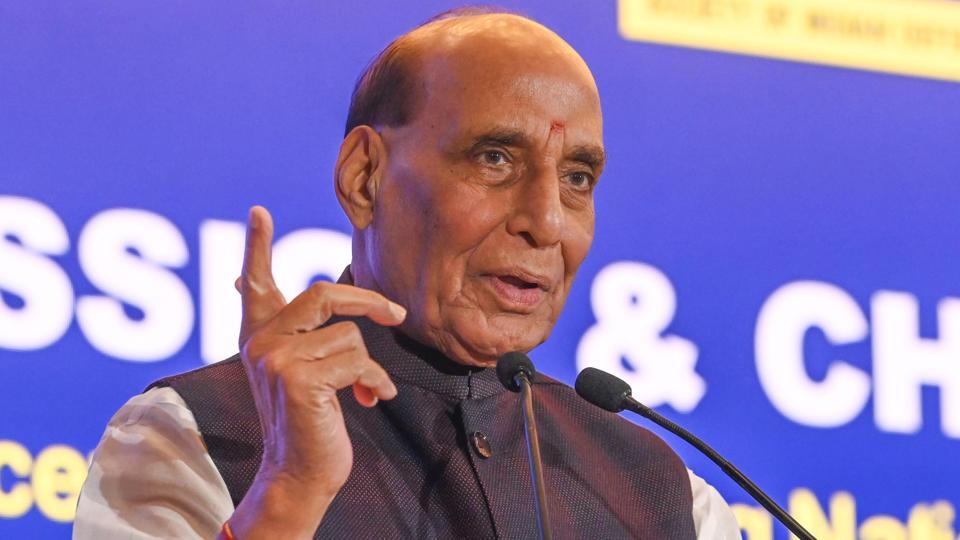
New Delhi should conduct in-depth assessments across all domains amid contemporary global uncertainties and step up efforts to pursue self-reliance by focusing on innovation and dominating supply and maintenance chains, Singh said while addressing the annual session of the Society of Indian Defence Manufacturers (SIDM).
Though India gave a “firm response” to Pakistan during the four-day conflict in May, Singh called for continued introspection. “Operation Sindoor should serve as a case study from which we can learn and chart our future course. This incident has once again shown us that anything can happen at our borders, anywhere, at any time,” he said.
“We need to be ready for a war-like situation, and our preparedness must be based on our own foundation,” Singh said. “The established world order is weakening, and conflict zones are increasing in many regions. It has, therefore, become necessary for India to redefine its security and strategy.”
Singh emphasised that in-depth assessments are required across all domains due to present-day global uncertainties, and that indigenisation is the only way to address challenges arising from the constantly evolving defence sector and the nature of warfare. In this context, he said that the effective use of indigenous military equipment during Operation Sindoor bolstered India’s regional and international reputation.
The power of indigenous equipment and platforms, such as the Akash missile, BrahMos cruise and Akashteer air defence control system, was witnessed during Operation Sindoor, and the credit for success should be shared by the armed forces and “industry warriors” engaged on the front lines of innovation, design and manufacturing, he said.
The government, Singh said, is creating a level playing field to enhance defence manufacturing and strengthen the domestic ecosystem, and the industry must make full use of this opportunity. The government is focused on establishing a real manufacturing base for defence hardware that embodies the spirit of “Made in India, Made for the World”, as well as initiatives for developing innovation such as the Quantum Mission, Atal Innovation Mission and National Research Foundation.
Singh also referred to progress in the government’s self-reliance efforts, saying that India was completely dependent on imports for its security needs before 2014, but now manufactures defence equipment. Defence production increased from around ₹46,000 crore in 2014 to ₹1.51 lakh crore, of which the private sector contributed ₹33,000 crore.
“Our defence exports, which were less than ₹1,000 crore 10 years ago, have touched a record [of] approximately ₹24,000 crore. I’m confident that defence exports would reach ₹30,000 crore by March 2026,” he said.
Singh urged the private sector to increase its contribution to domestic defence manufacturing from 25% to 50% in the next three years, including steps to dominate supply and maintenance chains and a focus on the manufacturing of individual subsystems and components.
The maintenance, repair, overhaul and spare parts management of major equipment purchased from abroad have significant financial implications and also perpetuates dependence on other countries, he said.