
 E-Paper



India nears sea-based nuclear triad as K-4 missile clears key test
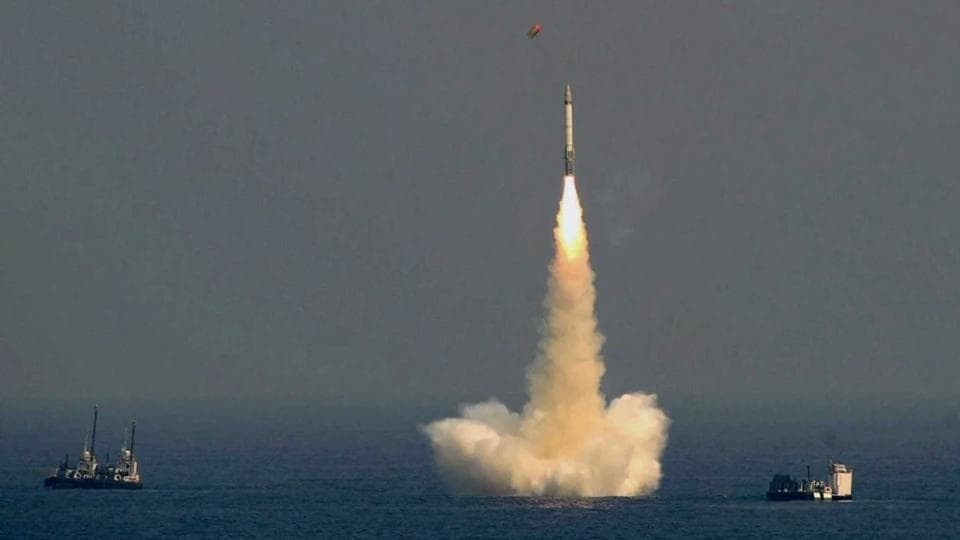
DRDO tested the K-4 missile, launched from Indian nuclear powered ballistic missile (SSBN) INS Arighaat, in the Bay of Bengal on December 23.

 Prefer HTon Google


India is set for the final operational validation of its sea-based nuclear triad with its 3500-km-range K-4 submarine launched nuclear ballistic missile requiring a few more test-firings before being inducted into the country’s nuclear arsenal operated by tri-services Strategic Forces Command (SFC). DRDO tested the K-4 missile, launched from Indian nuclear powered ballistic missile (SSBN) INS Arighaat, in the Bay of Bengal on December 23.
While the Modi government normally does not speak about the country’s nuclear platforms and missiles, HT learns that the test-firing of K-4 missiles was delayed from the previous schedule of December 1-3 as a Chinese Ocean Mineral Resources Vessel was sighted 115 nautical miles on the southern edge of the navigation area on December 3. This Chinese vessel, however, did not have any missile tracking equipment on-board.
Although Chinese research vessels “ Shi Yan 6, Shen Yi Hao and Lan Hai” were present in the Indian Ocean Region last month, a Luyang III destroyer (the only one currently), a Jiangkai II frigate and a Fuchi class tanker, all part of the 48th anti-piracy escort force, were off the Gulf of Aden.
Even though the K-4 missile requires a couple of more test-firings before induction, India is all set to commission INS Aridhaman, the third SSBN in Arihant class, in the first quarter of 2026. On October 16, Defence Minister Rajnath Singh launched S4*, the last of Arihant class SSBNs, which may be commissioned in the Indian SFC towards the end of decade. Barring INS Arihant, which carries on 750-km range K-15 nuclear missiles, all others in this class carry K-4 missiles. The next class of SSBNs will be around 10,000 tonnes and will carry K-5 missiles with a range more than 5,000km.
In the meantime, India has signed on to acquire the Akula class nuclear powered conventionally armed attack submarine (SSN) from Russia latest by 2028. While Russia has recently offered India another SSN on lease, the Modi government has cleared the Indian Navy’s plan to construct two SSNs under “Make in India” on October 9. The SSNs hold advantage over diesel powered attack submarines (SSKs) as they have unlimited range and are constrained only by food supplies, crew fatigue and maintenance. The SSNs carry more torpedoes and missiles and do not have to surface for charging batteries. The only advantage of SSKs is that they are very quiet as compared to SSNs and SSBNs and can be used for surprise attacks .
At present China and Turkey are supplying guided missiles frigates to Pakistan with Turkey upgrading Islamabad’s submarines and Beijing supplying new Yuan class submarines. Under the circumstances, India has strategic threats both in Arabian Sea as well as the larger Indian Ocean Region with Chinese aircraft carrier led patrols expected in 2026 after the commissioning of the latest Fujian heavy carrier. The Chinese carrier based pilots and platforms have also shown rapid learning skills and pose a threat to the Indo-Pacific. The only counter to surface threats in the Indian Ocean Region are Indian SSBNs and SSNs as onlya sea based deterrent has survivability and second-strike capability.


