E-Paper



India, Singapore launch mechanism to boost ties
The inaugural meeting of the India-Singapore Ministerial Roundtable (ISMR) was held during Singapore deputy prime minister Lawrence Wong’s visit to the country that began on Saturday. External affairs minister S Jaishankar said the two sides held an “open and freewheeling discussion on the possibilities and prospects of our ties in the coming decade”.


India and Singapore on Saturday launched a new mechanism headed by their ministers of foreign affairs, finance and trade to enhance economic cooperation and to identify new areas for collaboration.
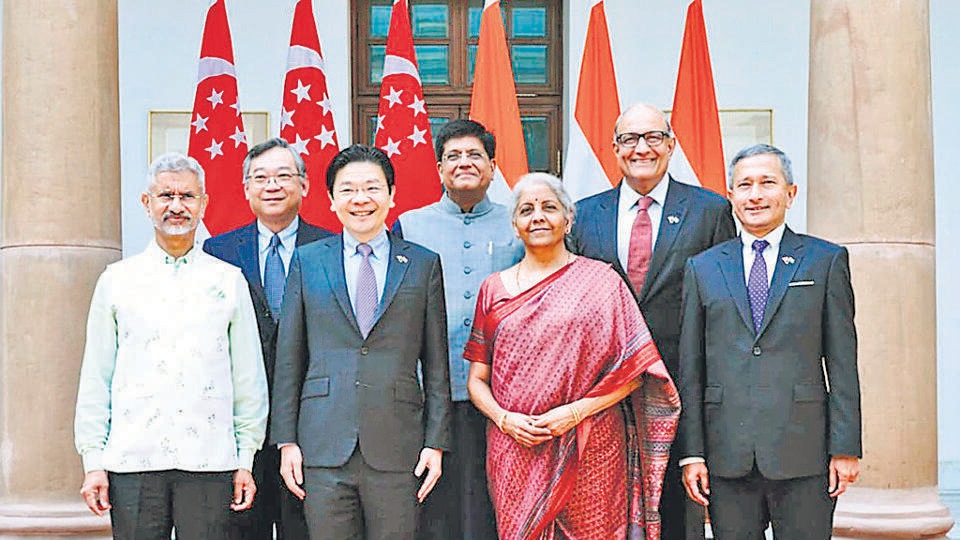
The inaugural meeting of the India-Singapore Ministerial Roundtable (ISMR) was held during Singapore deputy prime minister Lawrence Wong’s visit to the country that began on Saturday. External affairs minister S Jaishankar said the two sides held an “open and freewheeling discussion on the possibilities and prospects of our ties in the coming decade”.
The meeting assumes significance as Wong, who also holds the finance portfolio, was named by Singapore Prime Minister Lee Hsien Loong as his new deputy in June, paving the way for him to become the city state’s next leader. There is, however, still no clear timeframe for a change in leadership in the ruling People’s Action Party.
Wong is accompanied by a delegation that includes Singapore’s foreign minister Vivian Balakrishnan, trade and industry minister Gan Kim Yong and minister-in-charge of trade relations S Iswaran for his five-day visit to India. This is his first official visit to India in his capacity as deputy prime minister.
The Singapore ministers joined Jaishankar, commerce and industry minister Piyush Goyal and finance minister Nirmala Sitharaman for the maiden meeting of the ISMR, which is a new ministerial platform that seeks to deepen existing cooperation and identify opportunities for mutually beneficial collaboration in new and emerging areas.
Jaishankar tweeted that the meeting provided “considerable food for thought”. Wong said in a tweet that the two sides had a good discussion on topics such as food and energy security, digitalisation, green technology and skills development.
India’s finance ministry said the ministers emphasised ways of enhancing cooperation between India and Singapore in emerging and futuristic areas. Both sides deliberated on issues such as financial sector operations, fintech, regulatory cooperation, investment opportunities and current economic arrangements, the ministry added.
Wong thanked India, which is the president of the G20 for 2023, for inviting Singapore to the G20 Leaders’ Summit and other meetings next year.
The ministers from both sides were later joined by industry leaders from India and Singapore, who were holding a business roundtable in parallel.
Wong will meet senior Indian leaders and other personalities during his visit. He will travel to Gujarat on September 18 to meet chief minister Bhupendrabhai Patel and to visit Gujarat International Finance City.
On Thursday, Singapore unveiled plans for a massive revamp of its financial services industry by 2025 that is aimed at strengthening its position in the fight against climate change, mobilising capital to support sustainable financing and green fintech.
Wong announced the new roadmap to transform the financial services industry that envisages the creation of 3,000 to 4,000 jobs annually and average growth of between 4% and 5% each year. The plan will strengthen Singapore’s position as a finance hub in Asia against the backdrop of Covid-19 restrictions and concern about rival Hong Kong’s future in view of China’s growing scrutiny and tighter security measures.
The industry transformation map (ITM) includes a Singapore$100-million fund over five years to support sustainability within the finance sector in areas such as green fintech, new sustainable financing solutions and reinsurance.
“We know that we cannot build a regional and global financial centre with our local financial manpower alone and that’s why we continue to attract and retain top talent from abroad to form the best teams in Singapore,” Wong said.
Wong described Asia as a “key battleground” to fight climate change. “The financial sector must do its part – to mobilise capital through financing and investments that support the region’s transition to net zero,” he said.