E-Paper



India, Singapore seal five pacts, pledge to enhance trade and investment
India and Singapore agreed to bolster cooperation to drive India’s ambition to emerge as semiconductor manufacturing hub, including a “green lane” initiative

 Prefer HTon Google


NEW DELHI: India and Singapore on Thursday finalised five agreements to deepen cooperation in areas ranging from fintech innovation to a green shipping corridor as Prime Minister Narendra Modi and his Singaporean counterpart Lawrence Wong pledged to enhance trade and investments to cope with uncertainty in the global economy.
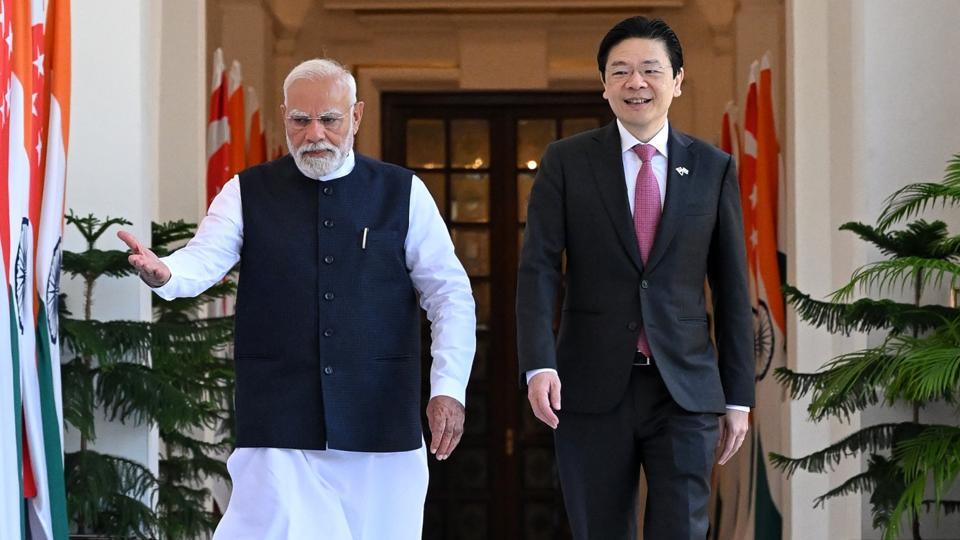
The two sides agreed to bolster cooperation to drive India’s ambition to emerge as semiconductor manufacturing hub, including a “green lane” initiative to optimise supply chains and minimise risks, and unveiled a roadmap focused on eight pillars, including economic cooperation, defence and security cooperation, digitalisation, connectivity, healthcare, and sustainability.
Wong, on his first visit to India after becoming prime minister, pledged to build on Singapore’s position as the largest source of FDI inflows for seven years by expanding cooperation in manufacturing, sustainable industrial parks, and supply chains and logistics. The two PMs virtually inaugurated the second phase of the Bharat Mumbai Container Terminal at Nhava Sheva Port, operated by Singapore’s PSA International.
“Today, in the Southeast Asian region, Singapore stands as our largest trading partner. Singapore has made substantial investments in India,” Modi said at a joint media interaction with Wong. “Singapore is a vital pillar of our Act East policy. Together, we will continue to advance cooperation with Asean and carry forward our joint vision for peace and stability in the Indo-Pacific region.”
Also Read: ‘Our confidence in India backed by proven track record, says Singapore PM Lawrence Wong
Wong added, “In a world marked by great uncertainty and turbulence, the partnership between India and Singapore becomes even more important because this is a partnership rooted in shared values, mutual respect and a deep reservoir of trust.”
Modi said the new roadmap to guide the bilateral comprehensive strategic partnership will take cooperation to new areas such as advanced manufacturing, green shipping and civil nuclear energy. The two sides have also agreed to carry out a time-bound review of the bilateral Comprehensive Economic Cooperation Agreement (CECA) and the Asean-India Trade in Goods Agreement (AITIGA) to accelerate trade, he said.
“Technology and innovation are strong pillars of our partnership. We have agreed to expand our collaboration in AI, quantum and other digital technologies,” Modi added. Wong said Singapore will continue supporting India’s skills development efforts, acting as a global partner for the National Centre of Excellence in Skilling in Chennai and helping set up state-level skills centres in areas such as aviation maintenance, repair and overhaul (MRO) and semiconductors.
Among the five agreements was a memorandum of understanding (MoU) on digital asset innovation between the Reserve Bank of India and the Monetary Authority of Singapore that will focus on developing more efficient digital financial channels to support cross-border financial flows, and an MoU between the Airports Authority of India and Civil Aviation Authority of Singapore for training, research and development. There are currently 246 weekly flights between Singapore and India, and the MoU will help both sides leverage their respective strengths to build capacity.
The MoU for cooperation on a green and digital shipping corridor is focused on infrastructure and technologies to enable uptake of zero or near-zero greenhouse gas emission fuels, including regulatory standards, and collaboration on digital solutions and smart port technologies to optimise maritime operations.
Another MoU will facilitate the setting up of the National Center of Excellence for Skilling in advanced manufacturing in Chennai, while the MoU on collaboration in space will bolster space industry cooperation. India has so far launched almost 20 Singapore-made satellites.
Modi also said India and Singapore share common concerns regarding terrorism, and urged all countries to unite in the fight against the menace. He thanked Wong for Singapore’s steadfast support in India’s fight against terrorism in the aftermath of the Pahalgam terror attack.
The new roadmap said the two sides will collaborate to combat global and regional terrorism and terror groups, including those proscribed by the UN Security Council’s 1267 Sanctions Committee, and terror financing through bilateral mechanisms and multilateral platforms.
P Kumaran, secretary (East) in the external affairs ministry, told a media briefing that Singapore continues to perceive India as an investment destination with significant growth amid global uncertainty. He noted that Singapore was India’s largest source of cumulative investments worth almost $170 billion while two-way trade had risen from $6.7 billion in 2004-05 to almost $35 bn in 2024-25.
In the context of India’s call for the speedy review of the AITIGA, Kumaran said the Singaporean side had agreed to explain New Delhi’s position to other Asean partners. India’s trade deficit with the 10 Asean states had increased since the the AITIGA came into force in 2010 and there was a need to “tweak arrangements to come to a more balanced trade situation”, he said.