India and the US should continue to stand together as leading democracies at a time when global threats to democracy and international freedoms are increasing, US secretary of state Antony Blinken said on Wednesday.
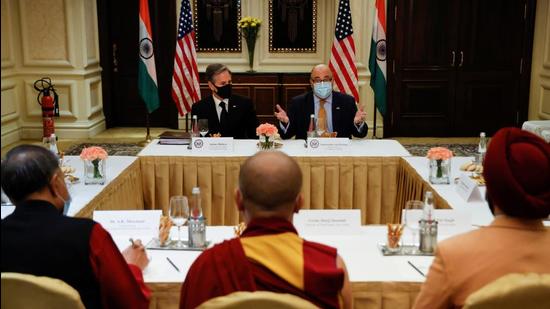
Addressing a civil society roundtable on the theme “Advancing equitable, inclusive and sustainable growth and development”, Blinken said both countries also need a vibrant civil society in order to make their democracies more open, inclusive, resilient and equitable.
Ahead of Blinken’s visit, the US side had said it intended to raise human rights and democracy during the secretary of state’s engagements in New Delhi. The US has in the recent past spoken out on issues such as the situation in Kashmir and movements such as the farmers’ protest on the outskirts of Delhi.
Also Read | US’s Antony Blinken in India: Afghanistan, Covid, economic recovery on agenda
The Indian side has usually been sensitive to such criticism and said before Blinken flew into New Delhi on Tuesday that is open to engaging on human rights and democracy with those who recognise the value of diversity. Defending its achievements in human rights and democracy, the Indian side also said both issues extend beyond a “particular national or cultural perspective”.
{{/usCountry}}The Indian side has usually been sensitive to such criticism and said before Blinken flew into New Delhi on Tuesday that is open to engaging on human rights and democracy with those who recognise the value of diversity. Defending its achievements in human rights and democracy, the Indian side also said both issues extend beyond a “particular national or cultural perspective”.
{{/usCountry}}In his opening remarks at the roundtable, Blinken described India and the US as democracies that are “works in progress”. Both sides talk about such issues as friends “because doing the hard work of strengthening democracy and making our ideals real is often challenging”, he said.
“At a time of rising global threats to democracy and international freedoms – we talk about a democratic recession – it’s vital that we two world leading democracies continue to stand together in support of these ideals,” Blinken said.
Referring to efforts in the US to become a “more perfect union”, he said: “That’s an acknowledgement from day one of our country that in a sense we will always fall short of the mark, but that the way to make progress is by constantly trying to achieve those ideals.”
He added, “As I said before, sometimes that process is painful, sometimes it’s ugly, but the strength of democracy is to embrace it.”
Blinken, on his first visit to India since becoming secretary of state, said India’s achievements include a “free media, independent courts, a vibrant and free and fair electoral system – the largest expression of free political will by citizens anywhere in the world”.
All successful democracies include thriving civil societies, and this ensures citizens become more fully engaged in the life of their communities, Blinken said.
“It’s how we organise and provide the resources to respond to emergencies. And we’ve seen people and organisations come together throughout Covid-19 in creative and incredibly generous ways, and civil society is also where we’re able to build meaningful connections across our social, religious, and cultural differences,” he said.
“In short, if we want to make our democracies more open, more inclusive, more resilient, more equitable, we need vibrant civil society,” Blinken said, adding that he wants to support more connections between civil society organisations in India and the US to make the partnership between the two democracies even stronger.
Later in the day, Blinken will meet National Security Adviser Ajit Doval, external affairs minister S Jaishankar and Prime Minister Narendra Modi. During these meetings, he said he would talk about many critical issues the two sides are working on together, including Covid-19, climate change, defence, mutual security, trade and investment, education, energy, and science and technology.
“When you put it all together, the relationship between our countries is one of the most important in the world. And I think that’s because not only is it a relationship between governments...but critically it’s through relationships between the Indian and the American people,” he said.