Commerce minister Piyush Goyal on Thursday formally operationalised the second major free trade agreement (FTA) in 2022 – the India-Australia Economic and Cooperation Trade Agreement (Ind-Aus ECTA) – by issuing preferential certificates of origin to some export consignments related to textiles, jewellery and pharmaceutical sectors in Mumbai.
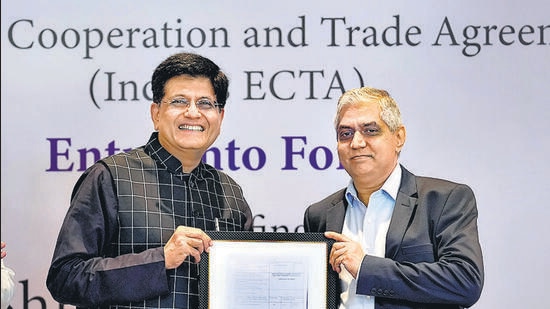
“All these products will attract zero customs duty,” a commerce ministry official said, as the minister handed over the certificates to exporters, marking the launch of the agreement. Exporters can file for a Preferential Certificate of Origin (CoO) under ECTA through a digital portal. Preferential CoO certifies that particular merchandise is either duty exempt or subject to reduced tariffs.
Although the trade agreement with Australia was signed on April 2, the two countries ratified it from their respective legislatures and completed all formalities on November 29 by exchanging the documents. As per the agreement, the deal came in force a month after the exchange of documents.
Also read: After US, Australia and UK, Saudi Arabia's warning for its citizens in Pakistan
Speaking on the occasion, Goyal said the agreement has been “negotiated with the speed of Bret Lee and the perfection of Sachin Tendulkar”, referencing cricket icons from the two countries.
{{/usCountry}}Speaking on the occasion, Goyal said the agreement has been “negotiated with the speed of Bret Lee and the perfection of Sachin Tendulkar”, referencing cricket icons from the two countries.
{{/usCountry}}Earlier on May 1, India’s FTA with the United Arab Emirates (UAE) became operational.
The agreement with Australia is India’s first such pact with any developed country in the last decade. The deal between world’s fifth and fourteenth largest economies provides a vast market for Indian goods and a source of raw materials for its domestic industry, a commerce ministry official said.
“There is a lot of potential for exporting finished goods to Australia, and since they hardly manufacture anything -- they are largely a raw material and intermediate producing country -- we will get cheaper raw materials which will not only make us more competitive globally but also enable us to serve Indian consumers better; enabling us to provide more quality goods at more affordable prices,” Goyal said.
He said Australia, which is largely dependent on imports, will also benefit “hugely” as it will soon start seeing “a lot more finished goods” coming in from India, he said.
“The Agreement will also eliminate double taxation on IT services which was making us less competitive and making us less profitable in the IT sector. The double taxation has now been removed by amending the law and from 1st April, we will save millions and millions of dollars, and going forward, over 5-7 years, the savings will be over a billion dollars, giving us a competitive edge and also creating a lot many jobs,” he said.
As per the agreement, India will be getting zero duty benefit on 98.3% of its exports to Australia from Day 1, and on 100% of tariff lines within five years. Tariffs on 85% of Australia’s exports to India will be eliminated immediately. The deal will benefit India’s IT industry, labour intensive sectors and students with post-study work visa.
It is estimated that an additional 1 million jobs would be created in India under ECTA. Indian Yoga teachers and chefs are set to gain with the annual visa quotas. Over 100,000 Indian students would benefit from post-study work visa (1.5-4 years) under the agreement, officials said.
Also read: RT-PCR test must for flyers from China, five other nations, says health minister
The deal will also increase investment opportunities, promote exports, create significant additional employment and facilitate strong bonding between the two countries.
India and Australia are also working on a more Comprehensive Economic Cooperation Agreement to build on ECTA in areas such as digital trade, government procurement, and new areas of cooperation.
India is Australia’s ninth largest trading partner, and the balance of trade is in Australia’s favour. During 2021, two-way trade in goods and services was worth $27.5 billion, with India’s exports valued at $10.5 billion and imports at $17 billion.
India’s merchandise exports to Australia grew 135% between 2019 and 2021. The main exports to Australia are refined petroleum, pharmaceutical products, pearls and gems, jewellery, made-up textile articles and women’s clothing, while India’s major imports were coal, copper ores and concentrates, natural gas, ferrous and non-ferrous waste and scrap, and education-related services.
According to an industry executive, the first-batch of consignments under India-Australia pact have been also flagged off from various ports of India such as Ennore and Surat among others. “Merchandise included pharmaceutical products, value-added millet items and engineering goods,” he said requesting anonymity.