India on Monday expressed deep concern at the escalation of the conflict in Ukraine hours after Russian air strikes targeted Kyiv and other cities, and reiterated its call for an immediate end to hostilities and a return to dialogue.
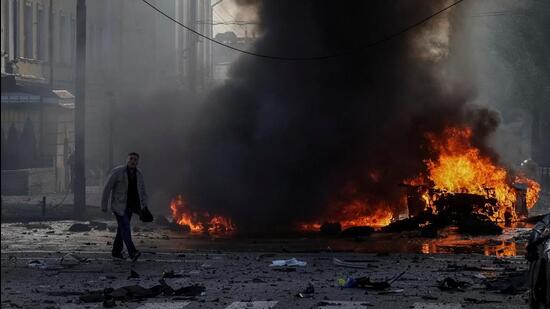
Russia fired cruise missiles at cities across Ukraine during the morning rush hour, killing civilians and knocking out the power supply. Russian President Vladimir Putin said the strikes were retaliation for Ukrainian attacks, including one on a key bridge in the annexed region of Crimea.
“India is deeply concerned at the escalation of the conflict in Ukraine, including targeting of infrastructure and deaths of civilians,” external affairs ministry spokesperson Arindam Bagchi said in a statement, without naming Russia.
“We reiterate that escalation of hostilities is in no one’s interest. We urge immediate cessation of hostilities and the urgent return to the path of diplomacy and dialogue. India stands ready to support all such efforts aimed at de-escalation,” he said.
The Indian reaction was in line with its stated position since the start of the Russian invasion of Ukraine on February 24 – that there should be an immediate end to the fighting and the two countries should resume dialogue and diplomacy to find a solution.
“India has consistently maintained since the beginning of the conflict that the global order is anchored in the principles of the UN Charter, international law and respect for sovereignty and territorial integrity of all states,” Bagchi said.
{{/usCountry}}“India has consistently maintained since the beginning of the conflict that the global order is anchored in the principles of the UN Charter, international law and respect for sovereignty and territorial integrity of all states,” Bagchi said.
{{/usCountry}}Prime Minister Narendra Modi told Putin at a bilateral meeting on the margins of the Shanghai Cooperation Organisation (SCO) Summit in Uzbekistan on September 16 that “today’s era is not of war”, and nudged him to end the conflict in Ukraine in view of the concerns among developing countries related to food and fuel security.
In a subsequent phone conversation with Ukraine’s President Volodymyr Zelenskyy on October 4, Modi reiterated his call for the cessation of hostilities and a return to dialogue and diplomacy. Modi said there can be “no military solution” and expressed India’s readiness to contribute to peace efforts. In the past, Modi has also suggested direct talks between the two leaders.
India has so far refrained from publicly criticising Russia for the invasion, and has abstained on most Ukraine-related resolutions at United Nations bodies. It has also shrugged off calls from the US and its European partners to take a position on the war in Ukraine and to not buy discounted Russian commodities, including crude oil.
Monday’s air strikes by Russia on Ukrainian cities amounted to a major escalation in the eight-month-old war. The cruise missiles hit busy traffic intersections, parks and tourist sites at the centre of Kyiv. Explosions were also reported from the western cities of Lviv, Ternopil and Zhytomyr, the eastern cities of Kharkiv, Dnipro and Kremenchuk and Zaporizhzhia in the south. Ukrainian officials said at least 10 people were killed and 60 more injured.
General Valeriy Zaluzhnyi, commander-in-chief of the Ukrainian armed forces, said on Twitter that 41 of the 75 missiles launched by Russia were neutralised by air defence systems.
Putin said in a televised address he ordered “massive” long-range missile strikes against energy and command and communication targets in Ukraine in response to “terrorist attacks”, including Saturday’s explosion on the Kerch Strait bridge that links Russia to the annexed Crimean region.