Sanand: India’s first ‘made-in-India’ semiconductor chip will roll out of Gujarat’s CG Semi Pvt Ltd in Sanand, Information Technology (IT) minister Ashwini Vaishnaw said at the inauguration of CG Semi’s pilot OSAT (Outsourced Semiconductor Assembly and Test) facility on Thursday.
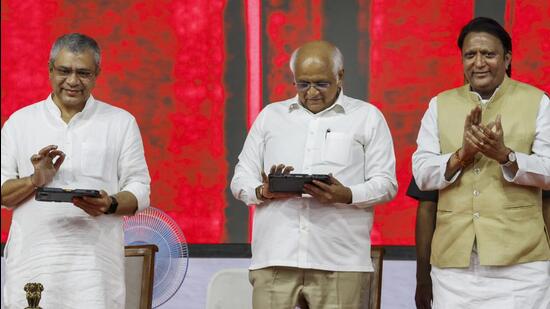
Prime Minister Narendra Modi had earlier said from the Independence Day dais that India’s first chip—which will be a packaged chip, assembled and tested in India, rather than one produced at a domestic fabrication facility—would be ready by the end of 2025.
Vaishnaw had previously said there was intense competition brewing among three semiconductor plants to claim the milestone. HT had reported that the first made-in-India chip would come from one of the three semiconductor units under construction in Sanand.
The Sanand OSAT facility is the country’s first end-to-end unit, the government said, developed by CG Semi, which holds a 92.3% stake. The project is in collaboration with Renesas Electronics and Stars Microelectronics, which hold around 6.8% and 0.9% equity, respectively.
Also Read: Made-in-India semiconductor chips will be available in markets by year-end: PM Modi
{{/usCountry}}Also Read: Made-in-India semiconductor chips will be available in markets by year-end: PM Modi
{{/usCountry}}Backed by the central government’s India Semiconductor Mission (ISM), the Sanand OSAT facility was cleared in February 2024 with an outlay of ₹7,600 crore over five years, and its foundation stone laid the following month. The project will house two units—G1, the pilot line, and G2, the larger commercial plant. The pilot unit, with an investment of ₹600 crore and employing 100–200 people, began production on Thursday. The main unit, with an investment of ₹7,000 crore, is expected to employ around 1,000 people once operational, a person aware of the matter said.
Thursday’s inauguration was only for the pilot OSAT facility. The larger unit—nearly 20 times bigger, with a built-up area of over 10 lakh sq ft and located three kilometers from the pilot line—is expected to be inaugurated next year.
The pilot line is crucial for customer validation, said the IT minister, adding that products made in the pilot line will be tested and qualified by customers before large-scale commercial production begins at the main plant.
The pilot line will have a capacity of 0.5 million chips per day. Together, G1 and G2 are expected to reach an installed capacity of 15 million chips per day, or 4.7 billion units annually, within the next five years. The chips will serve key sectors including consumer electronics, automobiles, and electric vehicles.
The IT minister added that the same phased approach will be followed for the Micron and Kaynes semiconductor plants in Sanand, starting with a pilot line before moving to full-scale commercial operations. The Micron plant is expected to be ready by December 2025 or January 2026.
Also read: Tech Tonic | Where are all of the world’s chips being made?
Of the 10 units approved under the ISM, four are in Gujarat, two in Odisha, and one each in Punjab, Assam, Andhra Pradesh, and Uttar Pradesh.
“It is India’s dream—that we design, manufacture semiconductors and then they be used in the downstream industries,” said Vaishnaw at the inauguration titled Prarambh, meaning “the start of something.”
Gujarat chief minister Bhupendrabhai Patel, who was present at the inauguration, said, “Under Prime Minister Modi’s leadership, India is moving towards self-reliance in critical technologies. We saw this during Operation Sindoor, where our Army deployed indigenously developed defence systems and demonstrated to the world that India is on par with leading nations.”
CG Power vice-chairman Vellayagn Subbiah said, “Many have questioned India’s ability to become self-reliant in semiconductors. But every chip we produce here is a step toward sovereign achievement. Three things are essential: first, our industry must adopt and use chips made in India, just as China did. Second, we must nurture Indian talent and bring engineers back. After all, 20% of the world’s semiconductor engineers are Indians. Third, we must invest in R&D to become true global leaders, because real leadership means going beyond assembly.”