Highlighting the need to collaborate as nations, institutions and individuals to find innovative solutions, Chief Justice of India (CJI) Dhananjaya Y Chandrachud on Saturday said that institutional collaboration is a precursor to solution-finding not only while adjudicating judicial questions, but it also plays a significant role in increasing access to justice.
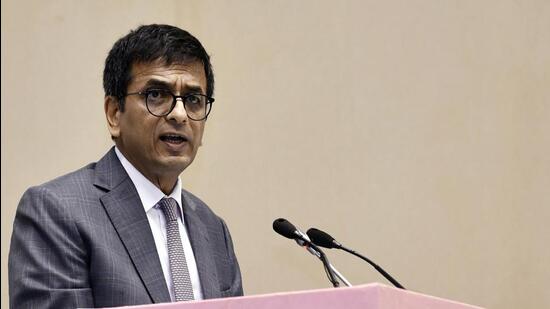
In his address at the inaugural session of the International Lawyers’ Conference organised by the Bar Council of India, the CJI made a note how individuals from diverse backgrounds came together to pass the Women’s Reservation Bill in Parliament and drew a parallel with the similar effort made seven decades ago when the Constitution was drafted.
“Individuals from different regions of India, diverse backgrounds and even conflicting ideologies came together to draft the Constitution in one voice ... We find the same bipartisan effort - and this is something to which we as citizens of India must be proud - has gone into the passing of women’s reservation bill in the Parliament,” said justice Chandrachud at the event, which also saw the presence of Prime Minister Narendra Modi.
The CJI’s speech focused on collaboration for engagement between nations, constitutions and legal systems. “It is utopian to think that there will be a day when we find perfect solutions and no challenges to justice delivery exist. However, it is definitely not utopian to aspire to a world where nations, institutions and most importantly individuals are open to engage with and learn from one another, without feeling threatened or belittled. It is in this engagement that I believe lies the framework to find solutions,” he said.
{{/usCountry}}The CJI’s speech focused on collaboration for engagement between nations, constitutions and legal systems. “It is utopian to think that there will be a day when we find perfect solutions and no challenges to justice delivery exist. However, it is definitely not utopian to aspire to a world where nations, institutions and most importantly individuals are open to engage with and learn from one another, without feeling threatened or belittled. It is in this engagement that I believe lies the framework to find solutions,” he said.
{{/usCountry}}Justice Chandrachud added nothing explains this push towards engagement across nations better than the slogan for the recently concluded G20 summit - ‘Vasudhev Kutumbhakam’- the world is a family.
While the Constitution provides for separation of powers between the legislature, executive and judiciary, the CJI said, it also creates a space for institutions to learn from each other and deliver justice.
“In our tendency to emphasise the differences, we often forget the abundant examples of collaboration between institutions to further the interest of justice. This holds true not only in lofty constitutional challenges, but more frequently, in the everyday interactions between courts and the government,” he said.
The CJI said that the judiciary and other institutions may place them at the different ends of the table but their ultimate aim is the same - for the nation to progress and prosper. “Institutional collaboration is a precursor to solution-finding not only while adjudicating judicial questions, but it also plays a significant role in increasing access to justice,” he said.
At the event, justice Chandrachud also highlighted that a budget of more than ₹7,000 crore was being made available for the third phase of the e-Court project.
“Just last week, the Union Cabinet chaired by the Hon’ble Prime Minister approved Phase III of the e-Court Project with a financial outlay of over ₹7000 crore. The e-Court programme, being implemented collectively by the e-committee, Supreme Court of India and the Union Ministry of Law & Justice, is a perfect example of institutions collaborating to make justice more accessible, affordable, and transparent,” he added.
On a parting note, the CJI urged lawyers to become more global in their outlook. “It is time for our lawyers to reach across the world in a global landscape. We cannot look at ourselves as domestic practitioners. We must look at the global platform,” he said.