The Delimitation Commission set up to redefine the boundaries of assembly and Parliamentary constituencies in the Union Territory (UT) of Jammu & Kashmir stuck to its proposal for six new constituencies in Jammu and one in the Valley in a draft it released on Monday, seeking comments till March 21.
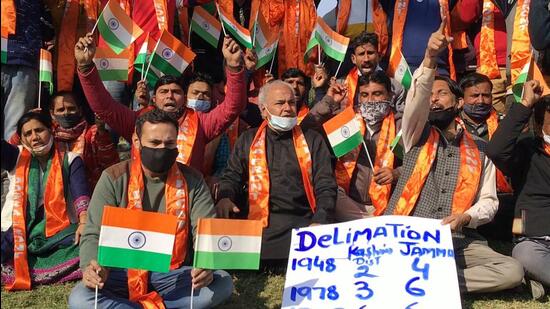
The draft sticks to the formula outlined by the commission in December, and opposed by most parties in the state; the draft includes a dissent note submitted by some of the associate members of the commission.
Delimitation is a key step in the move to hold elections in the UT, which could then be followed by the restoration of its statehood.
The proposal, published in the Gazette of India and the Gazette of J&K, outlines six new constituencies in the Jammu region and one new constituency in the Valley. It also proposes to carve out seven schedule caste and nine schedule tribe constituencies in the region.
“In pursuance of Section 8 of the Delimitation Act, 2002 (33 of 2002) read with Sections 14(4), 60(1) & 62 of The Jammu and Kashmir Reorganisation Act, 2019 (34 of 2019) and having regard to all other relevant Constitutional and statutory provisions in this regard,” read the report for public issued by K N Bhar, secretary Delimitation Commission along with constituency wise data.
The five associate members of the panel – Union minister Jitendra Singh of the BJP, NC chief Farooq Abdullah, NC MP Mohammad Akbar Lone, MP, NC MP Hasnain Masoodi and BJP MP Jugal Kishore Sharma — were first presented with the draft in December. The Commission has included dissent notes by National Conference MPs in its order.
{{/usCountry}}The five associate members of the panel – Union minister Jitendra Singh of the BJP, NC chief Farooq Abdullah, NC MP Mohammad Akbar Lone, MP, NC MP Hasnain Masoodi and BJP MP Jugal Kishore Sharma — were first presented with the draft in December. The Commission has included dissent notes by National Conference MPs in its order.
{{/usCountry}}People’s Democratic Party completely boycotted the process, with former chief minister Mehbooba Mufti alleging that the Commission was “serving the interests of the BJP”.
While the National Conference earlier distanced itself from the proceedings, it decided to rejoin it late last year. The NC MPs have opposed the proposal in its current state.
With reference to the latest draft, NC members have argued that the very constitutionality of the Commission is under scrutiny as a case is already pending before the apex court. It has also stated that the process of seat sharing has been in a biased and unfair manner, adding that it will not be a signatory to the report.
If the proposal is cleared, the total number of poll constituencies will rise from 83 to 90, with 43 in the Jammu region and 47 in Kashmir; 24 seats will be kept aside for Pakistan-occupied Kashmir. In the current state House, Jammu has 37 members and Kashmir has 46. The delimitation commission, which aims to carve out new poll constituencies in the region, was set up in March 2020 with five parliament members from the UT as associate members. It was given a yearlong extension in 2021, with two more months being accorded to the Commission in March this year. The delimitation process is important because it is the first step towards holding fresh elections in the region that has been under central rule for three years.
Jammu and Kashmir lost its special status and statehood on August 5, 2019, when the central government moved to void Article 370 of the Constitution. At a landmark all-party meeting in June, Prime Minister Narendra Modi told leaders of political parties that statehood will be restored after fresh elections are held in the region, on the basis of the delimitation process.
But parties from the region, which remain bitterly opposed to the scrapping of its special status, want statehood to be restored before delimitation and elections – a demand rejected by the Centre.
The commission, headed by former Supreme Court judge Ranjana Desai and also comprising election commissioner Sushil Chandra, has held multiple meetings in Srinagar and New Delhi, with several stakeholders and the associate members before finalizing the draft.