When things go wrong, the judiciary stands with its people, said Chief Justice of India (CJI) NV Ramana on Saturday, explaining the trust judiciary enjoys in India. He was addressing an international audience at the India-Singapore Mediation Summit 2021.
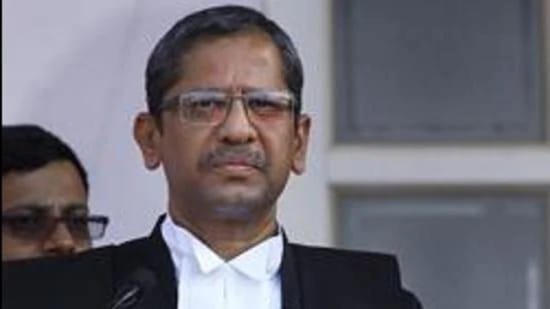
“People are confident that they will get relief and justice from the judiciary. It gives them the strength to pursue a dispute. They know that when things go wrong, the judiciary will stand by them,” the CJI said in his speech at the event. He stated that this trust explains why so many cases flood Indian courts.
At a separate event later in the day, launching an event held by Gujarat High Court for live-streaming the court proceedings, the CJI said, “It is high time for de-mystifying the justice delivery system in the country and furthering access through open courts.”
Although courts in the country are open to litigants and lawyers, access to justice will become a true reality when litigants and interested parties get to witness, understand and comprehend justice dispensation first-hand through the live-streaming, the CJI said.
The CJI hinted that at the Supreme Court, efforts are underway to open some courts for live-streaming as it is cost-effective. “People may want to follow the arguments of the lawyers and observations of the bench only in certain cases, such as those that involve Constitutional interpretation or attract public attention.” Currently, this information is available through the media. In the process, there can be some transmission loss leading to misinterpretation of questions asked and observations made by the bench, which often gets amplified by vested interests.
{{/usCountry}}The CJI hinted that at the Supreme Court, efforts are underway to open some courts for live-streaming as it is cost-effective. “People may want to follow the arguments of the lawyers and observations of the bench only in certain cases, such as those that involve Constitutional interpretation or attract public attention.” Currently, this information is available through the media. In the process, there can be some transmission loss leading to misinterpretation of questions asked and observations made by the bench, which often gets amplified by vested interests.
{{/usCountry}}“The formalisation of the live streaming of court proceedings is the best cure for the aforesaid malady,” the CJI said. However, he warned that live streaming of proceedings may become a double-edged sword as judges might feel the pressure of public scrutiny which can result in a stressful environment.
At the same time, the privacy of the parties involved and the safety and security of the victims and witnesses should also be ensured during live streaming, the CJI told Justice Vikram Nath, Chief Justice of Gujarat High Court and other judges of the High Court at the virtual event.
The CJI also sought to address the perception about pendency in Indian courts and said, “The often-quoted statistic that “pendency” in Indian Courts has reached 45 million cases, which is perceived as the inability of the Indian judiciary to cope with the caseload is an overstatement and an uncharitable analysis.”
Pendency cannot be a useful indicator of how well or poorly a system is doing, said Justice Ramana at the Indo-Singapore Mediation event which was also attended by Justice Sundaresh Menon, Chief Justice of Singapore.
The problem ailing the Indian judiciary is of delay, the CJI said and was of the strong view that the development of alternate dispute resolution (ADR) techniques, such as arbitration, conciliation and mediation, can have reduced delays by settling disputes outside courts. The current state of mediation in the country shows that since 2005, nearly 3.22 million cases have been referred and nearly 1 million cases have been settled till March 2021 by nearly 43,000 mediation centres.
To ensure mediation is successful, the CJI suggested that mediation should be prescribed as a “mandatory first step” for the resolution of every allowable dispute. “Perhaps, an omnibus law in this regard is needed to fill the vacuum,” as mediation is not governed by any law unlike the Arbitration and Conciliation Act 1996. Some recent laws, such as Commercial Courts Act 2015 and the Real Estate (Regulation and Development) Act 2016, provide a clause for compulsory pre-litigation mediation.
Since mediation is cheap and simple, it can benefit a vast majority of litigants in India who belong to middle and poorer sections of society, he said, giving the example of Lok Adalats which has helped reduce a lot of cases from coming to courts.
Over 7.84 million cases were settled by the Lok Adalats in 2019 and 2020 of which nearly 3.94 million cases were settled at the prelitigation stage.
At the start of his speech, the CJI highlighted that mediation, as a concept, is deeply embedded into the Indian ethos. He shared an event from the great Indian epic Mahabharata where Lord Krishna made a futile attempt to mediate the dispute between the Pandavas and Kauravas. “Failure of mediation led to disastrous consequences,” the CJI said.
Taking a leaf out of aviation, Justice Ramana said that just as commercial pilots have a simulator component in their training where they are equipped to respond to multiple scenarios, the training programmes of mediators should contain such a component. The CJI said that a game-like software for mediators would serve as a useful innovation.
The mediation event was organized by the Singapore International Mediation Centre, CAMP, Mediation Mantras, and the officers of the Supreme Court of Singapore and the Supreme Court of India.