This is the story of Sultan, Begum, Nawab, Saheb, Sultana, Sahiba, Sundari, Anokhi, Singhye, and Nacho Libre. They are the dogs who have been part of our family over the last three decades and the source of immense joy, laughter, solace, comfort—and grief—when they pass on.
Sultan was a rescued dog, a cross between a Labrador and an Indie, whom we adopted in the late 1980s. He grew into a handsome dog and, although much loved by the family, became
This is the story of Sultan, Begum, Nawab, Saheb, Sultana, Sahiba, Sundari, Anokhi, Singhye, and Nacho Libre. They are the dogs who have been part of our family over the last three decades and the source of immense joy, laughter, solace, comfort—and grief—when they pass on.
Sultan was a rescued dog, a cross between a Labrador and an Indie, whom we adopted in the late 1980s. He grew into a handsome dog and, although much loved by the family, became essentially my shadow. His whole life used to revolve around my routine. When he got lost—running away from the car near the vet’s clinic before the driver could chain him—I was inconsolable. We put an ad in the papers, announced an attractive monetary reward for anyone who found him, and lodged a complaint with the police. When more than a week had elapsed and we had almost given up hope, our efforts worked. He was spotted by someone in Chanakyapuri, and was back home.
Begum was a stray pup, separated from her mother and siblings, trying to survive in the vicinity of Miranda House, the girls’ college in the University of Delhi. My daughter, Mishri, who was studying there in the mid-1990s, picked her up and brought her home. It was decided that she would be happiest on our farm near Delhi. She grew into a very striking female, with stripes of brown across her black body, and lived for 14 years.
Nawab, a Spaniel, and Saheb, a Dachshund, were bought by my wife when we were posted in Moscow. Subsequently, they returned with us to Delhi. On the plane from Moscow to Delhi, they were confined to their kennels in the hold for live animals. Obviously, they were not very happy there, and audibly expressed their protest. The kind air hostess then brought them up and placed them on two seats next to us that happened to be empty, where they sat happily, wrapped in a blanket.
Also Read: Protests erupt at Delhi dog shelter centre over alleged cruelty
Sultana, a stray, walked into our driveway in Delhi and adopted us. Her life’s story is like some fairy tale. When I was posted as High Commissioner (HC) to Cyprus in 2001, she, along with Saheb (Sultan and Nawab had died by then), accompanied us. From Cyprus, I was asked by Prime Minister Atal Bihari Vajpayee to take over as Director of The Nehru Centre in London. But what would I do about Sultana? I learnt that if her blood sample was cleared from a designated laboratory in Athens, and a chip embedded in her neck, six months later she could enter London without quarantine. Accordingly, we left Sultana and our maid with close friends in Cyprus, and in six months, both of them joined us in London. Sultana lived in Mayfair, taking her morning walk every day in Hyde Park.
After London, I was back in Delhi on posting. Sultana was then joined by Sundari, an Indie—who, just like her, adopted us—Sahiba, a black Labrador, and Nacho Libre, a miniature Doberman. All four of them left with me and my wife, Renu, when I was posted as Ambassador to Bhutan. In the beautiful estate of the Ambassador’s residence, they, like us, were in clover. Then, in an unbelievable occurrence, Nacho, not more than 12 inches tall, managed to impregnate Sahiba, some 3 feet tall. From this highly unusual pairing was born a curious but lovely hybrid, whom we christened—quite naturally—Anokhi. To ‘rectify’ this deviation, the highly pedigreed Sahiba was ‘married’ to a Labrador of the extended Bhutanese royal family. This time she produced a litter of nine beautiful pups—some black like her, and some beige like the father. Four we gave to the ‘bridegroom’s’ family, four to friends in India, and one, a beautiful male beige pup, we kept ourselves, naming him, in honour of the paradise that is Bhutan, Singhye.
Also Read: Old challenges haunt SC’s new dog order. What lies ahead for Delhi?
After three years, when I resigned to join politics, four dogs came back to India. Sultana—the stray who lived in Delhi, Cyprus, London, and Bhutan—died in Bhutan, and is buried there under a magnificent chinar tree. The others too have passed on by now.
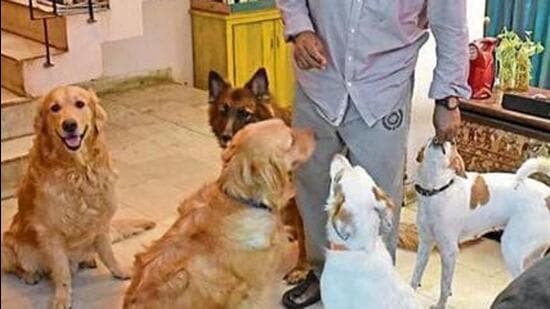
Now we have three new ones. Lucy, a stray, was given this name by a Lithuanian diplomat who found her as a pup lying injured on the road. He took her home, had her treated, and then put her up for adoption. We were delighted to do so. Miha is a rescued cross between a Labrador and a German Shepherd. We have also adopted Moku, an Indie. Last week, Moku was hit by a car and broke his hip bone. He was operated upon to have a plate and rod replace it. I love dogs, but Renu is the one capable of both love and care. On Moku’s first night after surgery, she slept on the floor next to him, administering water, soup, and medicines through the night.
It should be clear by now that my family and I are unabashed dog lovers. We are grateful that the Supreme Court has now overruled its earlier order and put in place a more humane policy for strays. On our part, more of us should adopt them instead of hankering only after so-called pedigreed breeds.
Pavan K Varma is an author, diplomat, and former member of Parliament (Rajya Sabha). The views expressed are personal
One Subscription.
Get 360° coverage—from daily headlines
to 100 year archives.
Archives
HT App & Website