
 E-Paper



Just Like That| Hema Malini says Dharmendra recovering as rumours revive legacy
In the luminous firmament of Hindi cinema, where stars rise like fleeting comets only to fade with time, Dharmendra stands out as rare celestial body

 Prefer HTon Google


Recent rumours of cine star Dharmendra’s death ahead of his 90th birthday were put to rest by his wife Hema Malini, who confirmed that he is very much alive and recuperating at home — a reassuring update, and we wish him a full and speedy recovery. The inaccurate news, though, prompted me to reflect on his remarkable cinematic career and indelible persona.
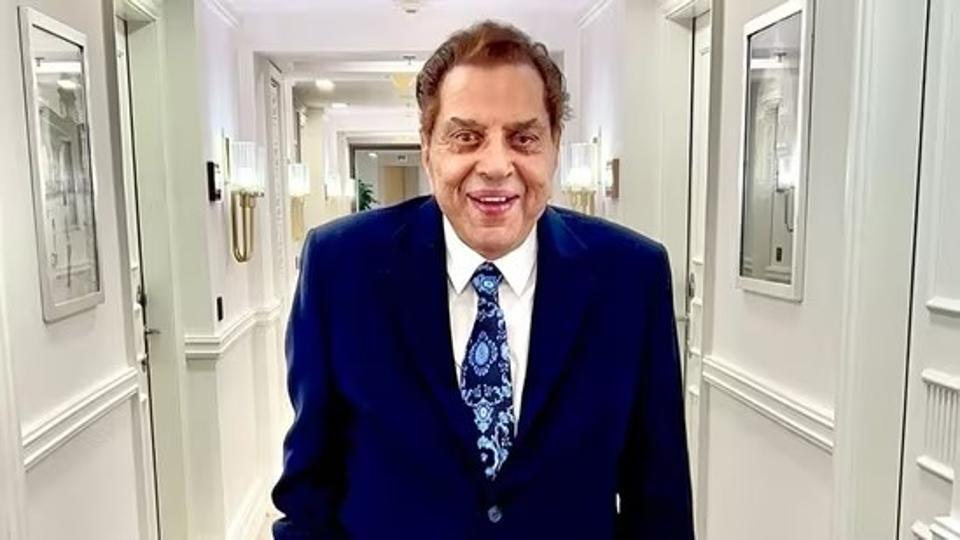
In the luminous firmament of Hindi cinema, where stars rise like fleeting comets only to fade with passing time, Dharmendra Kewal Krishan Deol stands out as a rare celestial body whose brilliance has endured for decades. He remains, to borrow the affectionate sobriquet that clung to his persona, the ‘He-Man’ of Bollywood — who was also the irresistible romantic hero and, surprisingly, a great comic.
Dharmendra’s screen persona is a fusion of contradictions: he is at once the gentle lover and the unflinching action man; the joyful sidekick and the imposing hero; the man next door and the deity of muscle-bound bravado. It is this elasticity — a combination of rustic vitality and urbane charm, the broad shoulders, the gleaming smile, the twinkle in his eye — that made him one of the few stars of his era whose appeal cut across age, region and class.
Born on 8 December 1935 in Nasrali, Punjab, into the humble home of a schoolteacher father and a mother whose quiet support framed his early life, Dharmendra made his way to Bombay in the late 1950s, drawn by the lure of cinema. His debut in the 1960 film Dil Bhi Tera Hum Bhi Tere may not have set the box office alight, but it planted the seed of an actor determined to carve his own space.
The 1960s saw Dharmendra steadily building his craft and market value. He delivered strong performances in films such as Anpadh (1962), Bandini (1963) and Haqeeqat (1964) — the latter a war drama that offered gravitas and pathos. The turning point arrived with Phool Aur Patthar in 1966, which proved a blockbuster.
In the 1970s he made several decisive pivots. Mera Gaon Mera Desh (1971) cast him as a man from the countryside who takes on a dacoit — setting up the template of the heroic action star with earthy roots. Then came the phenomenal Sholay (1975). Playing Veeru opposite Amitabh Bachchan’s Jai, Dharmendra swept into Indian popular memory. The film itself became a cultural phenomenon; its dialogues, characters and songs have become part of folklore.
Off-screen, he was known for his straightforward charm — unpretentious, affable, fond of simple pleasures. His nickname ‘Garam Dharam’, a cheeky play on his name, captured that friendly, warm-hearted disposition. It was this ability to remain grounded that also brought him briefly into politics. Few people may now remember that he served as a member of the Lok Sabha from Bikaner between 2004–09.
If his filmography provides one part of the story, his personality provides the other. Dharmendra’s appeal was not only in his physique but in his accessibility — in the sense that the audience did not feel they were watching some distant demigod but someone who could belong in their world. That he came from a small Punjabi village, that he laughed like the boy next door, that he embraced life’s pleasures without ostentation — these traits gave his larger-than-life image a human anchor.
His persona also endured because he was capable of reinvention. He began as a romantic hero in the early ’60s, matured into an action icon in the ’70s, and later embraced the ‘elder statesman’ role with grace. He never seemed trapped in self-parody, which is why his transitions remained credible. The most recent example of his remarkable ability to adapt to unforgettable character roles was his turn as Ranveer Singh’s grandfather in the delightful blockbuster Rocky Aur Rani Ki Prem Kahani.
What does Dharmendra leave behind? First, a body of work that maps the evolution of Hindi cinema — from the romantic dramas and social melodramas of the ’60s to the larger-than-life operatic action stories of the ’70s and ’80s. Watching his films is to trace the changing contours of Bollywood.
Second, a screen persona that remained rooted. Many actors adopt the façade of invincibility; Dharmendra never quite lost his warmth. That might be why even today viewers respond to him with a mixture of nostalgia and genuine affection.
Finally, his influence on later generations is tangible — not just because his sons (Sunny Deol, Bobby Deol) followed him into cinema, and that he married ‘dream girl’ Hema Malini, but because his combination of masculinity and sensitivity shifted what it meant to be a hero in Hindi films.
In the lexicon of Hindi film stardom, Dharmendra occupies a place that is at once iconic and quietly intimate. His career gave us action and romance, the fistfight and the tear, the roar and the laugh — and always the man we felt we could call ours.
As we revisit his films, we don’t just see the star lighting up the screen — we see the personality behind that star, the boy from Punjab who walked into Bombay and walked out into legend. In an age of fleeting fame, Dharmendra’s legacy reminds us that lasting appeal often lies in a blend of charisma and heart, power and gentleness — the very alchemy that made him, for so many, simply ‘Dharam’.
(Pavan K Varma is an author, diplomat, and former member of Parliament (Rajya Sabha). The views expressed are personal)


