While former chief minister D. Devaraj Urs is credited with renaming the Mysore state as Karnataka on November 1, 1973, historians and writers claim the name itself is centuries old.
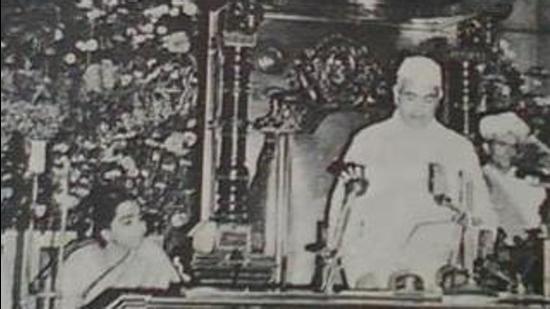
With the inclusion of the districts from erstwhile Nizam’s Hyderabad and Bombay presidency, many had felt the need to change the state’s name since districts from Mysore were just a part of the new state. It was then, in a large ceremony, Urs announced the new name.
One of the strongest arguments regarding the name Karnataka is around the Vijayanagara Empire. Even though the Vijayanagara Empire is known as one of the largest empires in the state, historians argue that it was known as the ‘Karnataka Desha’.
According to historian Vasundhara Filliozat’s works, several inscriptions show that the Karnataka Empire was founded in 1336. It was part of an attempt to bring all of south India together. The efforts began during the Hoysala ruler, Ballala III era, and by the time of king Harihara I, it started becoming a reality. It was eventually known as the Vijayanagara Empire, according to the colonial historical accounts.
“Based on inscriptions and iconography I studied for nearly a decade, the kingdom then was called Karnataka Desha. It is unclear why colonial historians glossed over the fact that the region was known as Karnataka and why post-Independence historians blindly followed these accounts,” Filliozat said.
{{/usCountry}}“Based on inscriptions and iconography I studied for nearly a decade, the kingdom then was called Karnataka Desha. It is unclear why colonial historians glossed over the fact that the region was known as Karnataka and why post-Independence historians blindly followed these accounts,” Filliozat said.
{{/usCountry}}Many historians argue that the empire was never called Vijayanagara. Even though the kingdom was known as Karnataka Desha, historians chose to follow the colonial accounts. They argue that there is a need to start referring to the Vijayanagara empire as Karnataka Desha.
Late Jnanpith Awardee and playwright Girish Karnad refers to the Vijayanagara region as “Karnataka Desha” in his play ‘Rakshasa-Tangadi’, which is based on A Social History of the Deccan, 1300-1761 by Richard M Eaton of the University of Arizona.
Historians argue that while recognizing the name Karnataka Desha for the Vijayanagara Empire wouldn’t be a hard task for the government, the question is how much of the state’s history, which is based on colonial accounts, needs a relook.
“This is not just about recognizing the fact that name Karnataka is an extension of the state’s heritage of having one of the largest and prosperous empires of the state, but there must be a need to have accurate history presented to the people, without the burden of the colonial history. The question is that if the state was not named Karnataka in 1973, would we have forgotten the name Karnataka, which once stood for one of the most prosperous empires in the country?” asked a senior history professor with a major university, who didn’t want to be named.
There are several other arguments regarding the derivation of the Karnataka, with one group suggesting the name was derived from words ‘Karu and Nadu’, which mean elevated land. Another group of scholars has argued that the name came from ‘Karu Nadu’, which means the land of black soil. It is even argued that the name came from ‘Kabu Nadu’, which means the land of sugarcanes.
While epidemiology remains a contested topic, the name Karnataka existing for centuries is not contested. Late author UR Ananthamurthy, in his writings, said that the word ‘Kannada Desha’ (the land of Kannada) is written in the Kavirajamarga, which is the earliest known literary work in Kannada. According to Ananthamurthy, who studied Kavirajamarga extensively, from Cauvery to the Godavari, where Kannada was spoken extensively, the land was termed as ‘Kannada Desha’. It was probably one of the earliest instances of defining a land by the language spoken by the locals. Kannada Desha eventually became Karnataka Desha, he argues.
“If you go beyond historic data, the mythological epics have the name Karnataka mentioned it. The earliest mention of Karnataka can be found in the great Sanskrit work Mahabharata. The name Karnataka could be found in Bhishma Parva and Sabha Parva. Also, ancient Sanskrit plays like Mrcchakatika by Shudraka cite the word Karnataka,” said Pradeep Koppal, a researcher on Karnataka history.
He also added that in the 5th century, astrologer Varaha Mihira used the term Karnataka in his work Brihatkath, and the Birur copper plate inscription of Kadamba dynasty king Vishnuvarma called king Shantivarma “the master of the entire Karnataka region”.
“In the 7th century, Rashtrakuta inscriptions refer to the armies of Chalukyas of Badami as ‘Karnatakabala’,” he added.