Even as physical classes for students above class 1 have resumed in Karnataka, however, the state government, parents, teachers and students are struggling to make up for the lost academic time for children who have been unable to attend schools for various reasons.
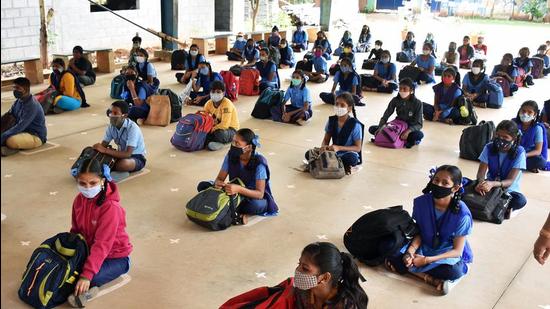
Despite the additional hours being put in by teachers to impart daily classes to students who are not present in school, teething issues like basic access to technology have come back to haunt education that had been stalled for nearly 18 months on account of the Covid-19 pandemic-induced lockdown.
Government school teachers said that they are going above and beyond the call of duty to impart some classes or supervision to online students but with little success.
HK Manjunath, a government school teacher and president of the Karnataka Rajya Prouda Shaale Saha Shikshakara Sangha said that this is depriving at least 20-30% of students.
“It has been over a year since students really got some classes. So it is difficult to make up for loss in the academic year for those who attend. And even more difficult for those who cannot attend classes for various reasons,” he said.
There are over 10 million students in these classes, according to the primary and secondary education department, out of which a survey carried out in July among 9.3 million children to establish their access to technology.
{{/usCountry}}There are over 10 million students in these classes, according to the primary and secondary education department, out of which a survey carried out in July among 9.3 million children to establish their access to technology.
{{/usCountry}}According to the survey, just over half of this number or 585,000 lakh students have access to a smartphone or tablet that leaves nearly 3.12 million students without any access to such devices.
Similarly, while around 5.1 million have access to the internet, nearly 3.8 million students don’t have any access to technology to help them cope with the academic year, rendering the exercise of online classes as a redundant practice for these children, mostly from rural and backward regions of the state.
Teachers said that they are trying to use their own resources and time to reach out to these children; but kids of daily wage labourers or others from poor backgrounds may not have such facilities.
People aware of the developments said that there have been attempts to bridge this gap by distributing tablets and coordinating efforts between several groups in rural areas to reach and teach students.
“If you look at the numbers, on average there are around 80-90% that we are covering. And we are exploring other ways to reach out to students who still do not have access to schools,” said one person from the primary and secondary minister’s office, requesting not to be named.
In Bengaluru (rural, south and north), there are 178,612 students who have been accounted for out of the total 1,992,100. Of this, only 1,387,299 have a mobile number in which they can be contacted and just 1,452,207 have access to smartphones or tablets. Only 1,305,527 students have access to the internet and at least 401,269 have no access, data from the education department shows.
The government appointed technical advisory committee (TAC), in its recommendations, argued that education is the fundamental right of the child and stated that reopening physical schools would optimise learning, physical and mental health as well as for nutritional aspects of children.
“Any further delay in school reopening may push children into malnutrition, child
labour, child marriage, child trafficking, begging etc., making their condition worse,” according to the report, submitted to the BS Yediyurappa-led government on June 22.
The mid-day meal programme has resumed, providing a life-line to many of these students but several who may have left for their villages or other parts of the state have no access to food or education.
Even though the state government has begun teaching classes on television and has created over 300,000 videos, classes and other content, however, data shows that there are 865,259 students who do not have access to radio or television in their homes.
Parents associations, at least in Bengaluru, have opposed the resuming of schools for children who are not yet eligible for vaccination, leaving them vulnerable to any infections especially with the third wave of Covid-19 infections looming large over the state. They have also alleged a collusion between private schools and the government to resume physical classes in order to ‘extort’ fees from parents and the pandemic-hit population.