E-Paper



What do Karnataka’s past trends tell us about these elections?
Karnataka will vote in a single-phase election on May 10, with results announced on May 13.

 Prefer HTon Google


All 224 assembly constituencies (ACs) in Karnataka will vote in a single-phase election to the state legislative assembly on May 10. While the exit polls after the end of voting will give their predictions on the results, the question is perhaps best left to be answered on May 13, which is when counting of votes will happen. This caveat notwithstanding, here are four charts which show Karnataka has voted in the recent past.
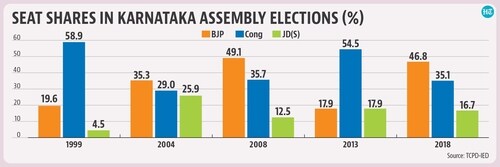
A tripartite contest at the state level…
Since the Janata Dal (Secular) or JD(S) fought its first elections in 1999, winning a simple majority in the state has not been easy. Only the Congress has won a majority of ACs, in 1999 and 2013, and in both elections, it had an extraordinary advantage against its opponents. While 1999 were the first assembly elections for the JD(S), the Bharatiya Janata Party (BJP) was facing a big rebellion in its ranks with leaders such as BS Yediyurappa and B S Sriramulu walking out of the party in 2013. Similarly, the BJP has emerged as the single largest party three times in assembly elections in Karnataka (in 2004, 2008, and 2018), but never won a majority on its own. This clearly shows that the third major party, the JD(S), is a formidable one in its own way. The JD(S)’s own performance in terms of ACs won has ranged from 4.5% in its first election in 1999 to a high of 25.9% in 2004. This is more than enough to play kingmaker in the state.
…without too many triangular contests at the AC-level
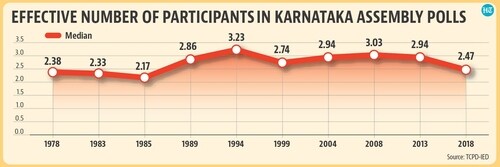
This is what makes the state of play in Karnataka very interesting. Most AC-level contests in the state are anything but three-cornered, as the JD(S) enjoys a limited (but formidable) geographic support base in the southern part of the state.
An analysis of Effective Number of Participants (ENOP) – it is the reciprocal of the sum of squares of vote shares in a constituency and a higher value denotes a more fragmented contest – shows this clearly. The median or middle value of ENOP has been above three only twice in Karnataka elections: in 1994 and 2008. In the last assembly election in 2018, it was the lowest since the 1989 election. This means that outcome at the state level is not a reflection of how multipolar the election is at the AC-level.
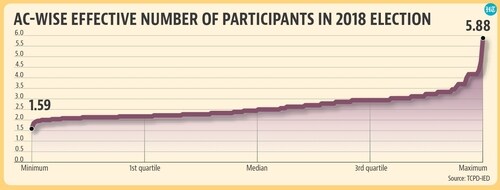
The major contest will still be between the Congress and the BJP
An analysis of AC-wise contests from 1999 onwards – it was the JD(S)’s first election – shows that the Congress has finished first or second in 185-197 out of the 224 ACs in the state. AC boundaries are not comparable before and after 2008 because of delimitation. In these ACs, the BJP was 1.3 to 3.1 times more likely than the JD(S) to finish first or second, which means that the two national parties are still the major competitors in the state.
But BJP breaking new ground in southern Karnataka could change things
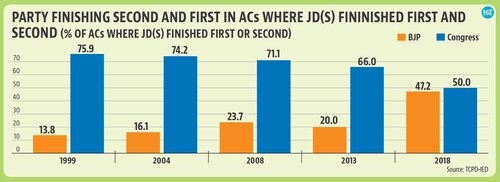
One reason why AC-wise contests in Karnataka are not triangular in nature is the absence of the BJP from the traditional stronghold of the JD(S) in southern parts of the state. This can be seen by checking who finished first and second where JD(S) finished second and first. This shows that Congress is three to six times more likely than the BJP to finish first and second in ACs where JD(S) finished second and first. However, the BJP surprised both the JD(S) and the Congress by doing very well in these regions in the 2019 Lok Sabha elections. While an advantage in national elections compared to state polls is now an established pattern for the BJP, a replication of this pattern could change the tripartite but not triangular nature of electoral competition for the state.