A key document on the state of the climate is on Monday expected to issue stark warnings to world leaders about the climate crisis and its consequences, experts said, in a development that comes after hundreds of scientists and government representatives reviewed the report.
The Intergovernmental Panel on Climate Change will release its ‘Climate Change 2021: The Physical Science Basis’ report on Monday. The 40-page IPCC report, which has been thoroughly reviewed by hundreds of experts, scientists and representatives of 195 governments, including India, has emerged as one of the most significant documents informing political leaders on the state of climate ahead of the UN climate negotiations (COP26) in November.
The report is expected to provide the most updated physical understanding of climate crisis impacts – how and why climate has changed, whether it is caused due to human influence; future scenarios like how quickly we are likely to breach the 1.5 degrees C and 2 degrees C thresholds, and what that would mean in terms of extreme weather events such as floods, sea-level rise, and glacial retreat, particularly in the Arctic. The findings will be crucial for India because IPCC will, for the first time, provide a localised outlook, with maps, atlas and others.
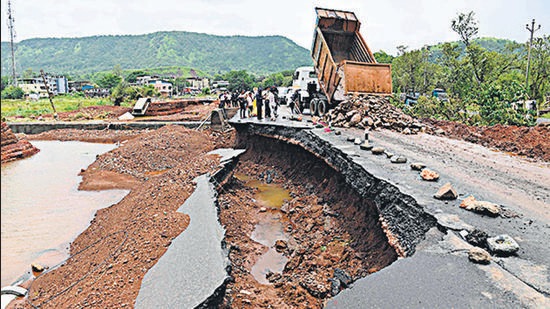
Over the last couple of monsoon months, India has been facing severe impacts of the climate crisis,including devastating floods in the Konkan region, a spate of cloudbursts and floods in Uttarakhand and Himachal Pradesh, and nearly 100 deaths due to lightning incidents.
{{/usCountry}}Over the last couple of monsoon months, India has been facing severe impacts of the climate crisis,including devastating floods in the Konkan region, a spate of cloudbursts and floods in Uttarakhand and Himachal Pradesh, and nearly 100 deaths due to lightning incidents.
{{/usCountry}}IPCC was established by the United Nations Environment Programme (UNEP) and the World Meteorological Organization (WMO) in 1988 to provide political leaders with periodic scientific assessments concerning climate change, its implications and risks. This time, the IPCC findings will be significant on two counts, according to experts.
One is that climate models and statistical methods have improved greatly in the past few years since IPCC’s fifth assessment report in 2014. “The present assessment report (sixth assessment) is based on much improved climate models and also using more observed and paleoclimatic data. Therefore, future projections of the climate could be considered to have reduced uncertainty,” said M Rajeevan, former secretary, ministry of earth sciences. So, we are likely to see more “high confidence” assessments in the report giving people a very realistic picture of how climate change will impact lives.
The second reason is because it is widely understood now by the scientific community that we are very close to breaching the 1.5 degrees C global warming threshold. According to highlights of the Global Annual to Decadal Climate Update by the UK’s Met Office and WMO released in May, there is a 40% chance of the annual average global temperature temporarily reaching the tipping point of 1.5 degrees Celsius above pre-industrial levels during the next five years. The findings of the report prompted Petteri Taalas, the WMO secretary general, to warn the world is getting “measurably and inexorably” closer to that threshold.
But, nationally determined contributions made by countries are currently woefully short of meeting the Paris Agreement goal of limiting global warming to well below 2 degree C and pursuing efforts to limit it to 1.5 degree C.
According to United Nations Environment Programme’s Emissions Gap Report 2020, the world is heading for a temperature rise of over 3 degree C this century. The ambition of various nationally determined contributions (NDCs) will have to be tripled to meet the 2 degree C target and increased by at least 5 times to meet the 1.5 degree C goal and that current pledges under the Paris Agreement are inadequate and could only limit global temperature rise to 3.2 degree C, the report had warned.
“The climate plans submitted by more than 90 countries so far will reduce only 2.3 billion tonnes of greenhouse gas emissions by 2030. What we need is ten times that emission reduction, otherwise our planet will warm by more than 1.5 degree Celsius. IPCC science warns us that even small degrees of average warming can lead to more heatwaves, floods, cyclones, and sea level rise,” said Ulka Kelkar, director of the climate programme at the World Resources Institute.
“One of the key takeaways from this report will be whether the mitigation strategies submitted by nations through the Paris Agreement are sufficient to keep the global temperature rise within the 1.5°C or 2°C limits or not. Based on the current commitments and emission scenario, it does not seem so. We have better data and higher resolution climate models since AR5, and they indicate that we might break the 1.5°C limit in the current decade or next and the 2°C during 2040–2060,” said Roxy Mathew Koll, climate scientist, Indian Institute of Tropical Meteorology.