The landslide that struck a national highway in Himachal Pradesh’s Kinnaur district has brought back focus on the delicate ecology of the region, which has been weakened further by human-induced climate change and unchecked construction of power projects, experts say.
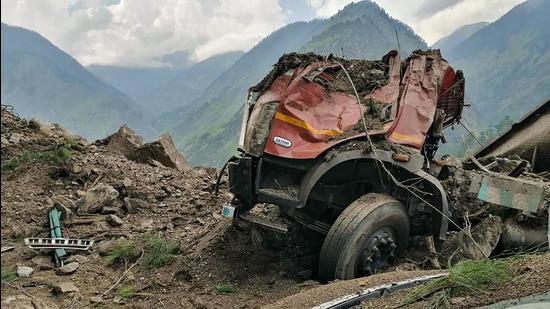
These factors together raise the possibility of landslides and floods, which loom as a threat in addition to the seismological features that predispose the region to earthquakes, which can further trigger big landslides.
Manshi Asher of Himdhara Collective, an environment group based in Himachal, summarised these as three factors that made the region vulnerable to disasters: fragile ecology, climate change and unplanned development.
“Kinnaur, located in greater Himalayas, is inheritably fragile. Due to a lot of tectonic movement the region is highly sensitive seismically and geologically,” said Asher.
Climate change, she added, has further aggravated the problem. “Global warming has resulted in a change in rainfall pattern. Areas like Kinnaur which used to get less rains, have been witnessing high rainfall now”.
“And the last and most vital issue is haphazard construction taking place in these mountains,” she said, citing large hydropower projects that have come up or are planned in Kinnaur, at present inhabitant mostly by mountain tribes. The tunnelling, excavation and blasting work being done to build these dams threatens an already fragile landscape, Asher added.
{{/usCountry}}“And the last and most vital issue is haphazard construction taking place in these mountains,” she said, citing large hydropower projects that have come up or are planned in Kinnaur, at present inhabitant mostly by mountain tribes. The tunnelling, excavation and blasting work being done to build these dams threatens an already fragile landscape, Asher added.
{{/usCountry}}A study carried out in Kinnaur between 2012 and 2016 found that a push for hydropower projects in the name of clean energy brought rapid land-use changes that adversely impacting local terrestrial ecosystems and communities inhabiting them.
It found that of the area of forest land diverted to non-forest activities between 1980 and 2014, 90% was transferred for hydro-electric projects and transmission lines, leading to fragmentation of forests and loss of biodiversity in the Kinnaur region.
Asher said Nigulsari is in close proximity to one of the largest hydropower project in the state – the Nathpa Jhakri.
Ambrish Kumar Mahajan, professor at the School of Earth and Environmental Sciences, Central University of Himachal Pradesh, agreed with Asher’s assessment. “Kinnaur is fragile due to the highly jointed and fractured geology,” he said.
Then, there are steep slopes and a lot of development activities along it. “Clubbed together, these factors have made Kinnaur a hub of landslide disasters,” he said.
He said the risk extended to Himachal Pradesh as a whole, and this has been borne out in several instances.
In addition to the warnings, some of the red flags came from within assessments by the government’s own departments. The environment department of Himachal Pradesh government, in its State Climate Change Strategy and Action Plan in 2012, warned that floods, landslides, glacial lake bursts, excess rainfall, excess snowfall and unseasonal rains will pose a threat.
It said the state could experience a difference of 1-5 degrees C in minimum temperature and 0.5-2.5 degrees C in maximum temperature by 2030.