...
...
Next Story

Kutch canal patch stops Narmada in its tracks

KBC is part of the ambitious Sardar Sarovar project, hailed as the country’s largest irrigation project with more than 60,000 kms of the canal network.

Updated on: Jul 8, 2022, 04:24:06 IST
Advertisement

Hours after successfully taking the waters of Narmada to Modh Kuva, the village at the tail-end of the Kutch Branch Canal (KBC), the authorities had to stop the flow after a patch in the path breached on Thursday.
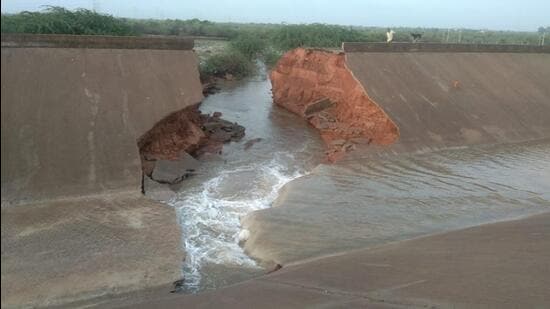
Hours after successfully taking the waters of Narmada to Modh Kuva, the village at the tail-end of the Kutch Branch Canal (KBC), the authorities had to stop the flow after a patch in the path breached on Thursday. (HT Photo)

“We were conducting trials for the last week, and for the first time the waters reached Modh Kuva late on Wednesday night. The 750 kms flow from the Sardar Sarovar dam site is the longest in the country for a man-made canal. In one part, the canal developed a breach, and we plan to repair it and restart the trials in the next 2-3 days. The trial aimed to look out for any issues and address them immediately,” J P Gupta, chairman of Sardar Sarovar Narmada Nigam Ltd (SSNNL) said.

KBC is part of the ambitious Sardar Sarovar project, hailed as the country’s largest irrigation project with more than 60,000 kms of the canal network. Gupta said that preliminary investigation showed that the place where the pipeline was damaged had some issues in the joint area with some private pipelines running beneath. Whether it was a technical issue or some reason, we will find out after investigation, he said.

The 6,493 crore KBC project aims to bring 1,02,200 hectares of land under irrigation and provide drinking water to 906 villages in the semi-arid region of Kutch, the country’s largest district. Of the seven branch canals, six have already been completed and commissioned, providing water to North Gujarat and Saurashtra regions. The work for more than 200 kms on Kutch Branch Canal was completed about four years ago, and the remaining stretch was stuck due to issues related to land acquisition, said people familiar with the development.

The waters reached Modh Kuva around 1 am on Thursday, four hours before the breach was found at Bidada village, about 315 kms from the offtake point, said sources close to the development.

“The patch that got damaged on Thursday was completed in 2016. The breach was 10 meters deep,” said an official in the know of the matter.

As the Narmada waters began flowing the villages of Kutch the villagers cheered, lit the sky with fireworks in celebration and praised Prime Minister Narendra Modi for the completing the project.

Also read: Eastern Rajasthan Canal Project won’t stop, says CM Ashok Gehlot

SSP is an inter-state project with a terminal dam on the Narmada river at Kevadia in Gujarat. A multi-purpose project with irrigation, power and drinking water benefits, it is meant to benefit Madhya Pradesh, Maharashtra, Rajasthan and Gujarat. SSNNL is implementing the SSP project.

In September 2017, seventy-one years after it was conceived, a completed Sardar Sarovar Dam—one of the biggest in the country—was dedicated to the nation by Prime Minister Narendra Modi.

 
ABOUT THE AUTHOR
Maulik Pathak

He is an Ahmedabad-based journalist with more than two decades of experience. His career spans business journalism and general news, with reporting across politics, crime, governance, public policy, business, industry, infrastructure, energy, ports, aviation, the environment, wildlife and social issues. He began his career in feature writing before moving into business journalism, reporting on companies and sectors including energy, infrastructure, pharmaceuticals, automobiles and real estate. Over the years, his work expanded to politics, courts, crime, public policy, civic affairs, the environment and wildlife. His reporting has taken him from government offices and courtrooms to factory floors, ports, forests and remote villages, covering stories that range from industrial investments and financial markets to elections, conservation and issues affecting everyday life. While many assignments demand the pace of the daily news cycle, others require sustained reporting over months and years to follow developments beyond the headlines. He started his journalism career with the Asian Age in Ahmedabad in 2002 as a feature writer and sub-editor. Since 2022, he has been working with Hindustan Times. Earlier, he worked with Business Standard, DNA, The Economic Times, Mint and The Times of India. His longest stint was with Mint, where he spent more than eight years reporting across multiple beats. During his career, he has worked in both reporting and editing roles, contributing to page planning, local editions and special editorial projects as newsrooms evolved from print-first operations to digital publishing. Early in his career, he also worked on media and documentary projects with an NGO and as a copywriter at a communications agency before returning to journalism. Away from work, he sometimes makes time for a pair of binoculars, table tennis, cinema and the occasional poem.

Get the latest India News, breaking headlines and real-time updates from across the country. Stay informed about politics, government policies, crime, weather and major national developments.
SHARE THIS ARTICLE ON
Hindustantimes wants to start sending you push notifications. Click allow to subscribe