A lawsuit alleging sub-human working conditions and meagre wages for workers from India at a temple built, maintained and run by a prosperous and well-connected Hindu community has spread to four other US states from the first accusations that were levelled against a New Jersey temple in May.
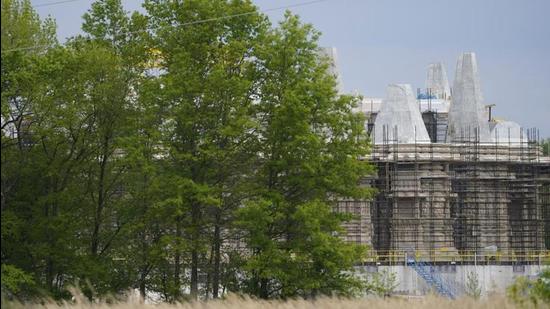
Similar wages of $1.20 an hour were paid to workers at this community’s temples in Chino Hills, a Los Angeles suburb in California; Bartlett, a Chicago suburb in Illinois; Stafford, a Houston suburb in Texas; and Lilburn, an Atlanta suburb in Georgia. The initial lawsuit was filed about the temple in Robbinsville, New Jersey, which is said to be the largest Hindu temple in the United States. The expanded lawsuit was filed in October, as first reported by the New York Times.
These temples belong to an organisation called the Bochasanwasi Shri Akshar Purushottam Swaminarayan Sanstha, Inc (BAPS), which is run by members of a Hindu community called the Swaminarayan Sampradaya. The sect has 3,850 centres around the world. They have hosted and co-hosted Diwali celebrations on Capitol Hill, home to the US Congress, that have been attended by a large number of lawmakers, White House officials and Congressional aides.
The New Jersey temple was raided by the FBI in a “court-authorized action” under the lawsuit filed in May by six workers by name and 200 in all.
{{/usCountry}}The New Jersey temple was raided by the FBI in a “court-authorized action” under the lawsuit filed in May by six workers by name and 200 in all.
{{/usCountry}}The lawsuit says that temple officials’ “actions constitute forced labour, trafficking with respect to forced labour, document servitude, conspiracy, and confiscation of immigration documents in the course of and with the intent to engage in fraud in foreign labour contracting”.
The lawsuit brings claims under the Trafficking Victims Protection Act (“TVPA”) and the Racketeer Influenced and Corrupt Organizations Act (“RICO”), which has been used by US authorities to bust the American Mafia.
The expanded lawsuit filed on October 23, alleges workers at the sect’s temples in California, Illinois, Texas and Georgia “also worked long hours for very little pay, suffering violations of their employment and civil rights”.
They were paid the same $1.20 an hour, which was the rate in the US way back in 1963 and is now considerably below the federal and state minimum wages. But working hours and conditions were better — they worked eight hours a day, compared to 12 and a half hours put in by those at the New Jersey temple. They were required to work seven days a week, with one day off a month while New Jersey workers worked seven days a week with just a few days off a year.
These workers, who were brought to the US on R-1 visas for those offering religious services, are mostly from marginalised communities in India. The lawsuit alleges the temples “intentionally” employed workers from the Scheduled Castes and the Scheduled Tribes and temple officials “did what they could to remind these marginalised workers of their place in the social hierarchy”. One official named in the lawsuit is alleged to have called the workers “worms”.
The temple organisation told US authorities these workers were coming as religious “volunteers”, the lawsuit said, adding, “In reality, however, the Plaintiffs and other R-1 workers performed solely manual — not religious — labour at the temples” and they were not volunteers.
“US government officials have authorized the use of R-1 visas for stone artisans for 20 years, and federal, state and local government agencies have regularly visited and inspected all of the construction projects on which those artisans volunteered,” Paul Fishman, an attorney representing BAPS, said in an email to Associated Press.
As at the New Jersey temple, workers at California, Illinois, Texas and Georgia “generally slept in a large hall or other buildings in the respective temple compounds”, the lawsuit states. Security guards were posted at the compounds, and the R-1 workers were not allowed to possess their passports.
“For a time when working at the Los Angeles temple, the R-1 workers were required to live in a hotel that was walking distance from the temple, and supervisors escorted them between the Los Angeles temple and the hotel.”
As in New Jersey, workers at the four additional locations were prohibited from talking to outside visitors and violation of this rule would be punished with cuts in their payment, which were meagre, to begin with, or being sent back to India.