Jaipur: Rajasthan high court chief justice Akil Kureshi on Saturday said he was leaving with his “pride intact” and considered the government’s “negative perception” about him as a certificate of independence.
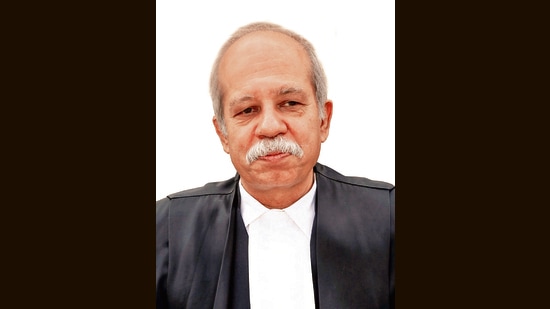
Justice Kureshi retires on Sunday.
“Recently a former CJI has written his autobiography. And going by media reports, he has made certain disclosures regarding changing recommendation to appoint me from Madhya Pradesh chief justice to Tripura chief justice based on judicial opinion,” he said.
“As a judge of a constitutional court, whose most primary duty is protecting the rights of citizens, I consider it as a certificate of independence,” justice Kureshi said in an emotional farewell speech at the Jodhpur bench of the Rajasthan high court.
His reference was to former CJI Ranjan Gogoi, who mentioned in his book that justice Kureshi could not be appointed to the Madhya Pradesh high court due to a “negative perception” about his judicial orders in the government. The Supreme Court collegium recommends appointments to the apex court to the central government.
Speaking on that disclosure, justice Kureshi said: “What is of greater significance to me is what is the perception of the judiciary (about me), which I have not been officially communicated.”
{{/usCountry}}Speaking on that disclosure, justice Kureshi said: “What is of greater significance to me is what is the perception of the judiciary (about me), which I have not been officially communicated.”
{{/usCountry}}In 2018, the government did not agree to the collegium’s recommendation to appoint justice Kureshi as the Madhya Pradesh chief justice from the Bombay high court, to which he was transferred from the Gujarat high court, where he was the most senior judge.
Also Read | As govt intervenes, collegium tweaks resolution on Akil Kureshi
The collegium settled for his appointment as chief justice of the Tripura high court, a smaller court having four judges. Just six months before retirement, justice Kureshi was appointed the chief justice of the Rajasthan high court. Justice Kureshi, as a judge in the Gujarat high court, had heard cases related to fake encounters in the state, among others.
Justice Kureshi said on Saturday that he had no “regrets” about the judicial orders he pronounced.
“Each decision of mine was based on my legal understanding. I have been wrong, I was proved to be wrong on many occasions, but never once have I decided something different from a legal belief,” he said.
“I leave with my pride intact that I made no decision based on its consequences on me that some people believe I should have made for progress,” he said. “If ever I have to make a choice between appreciation and so-called progress, I would gladly choose the former.”
Justice Kureshi also spoke about courage and sacrifice to uphold the rights of citizens. “So far, there have been 48 CJIs but when we talk of courage and sacrifice to uphold the rights of citizens, we remember one who should have been CJI, justice HR Khanna, who was the shining dissenting voice in the ADM Jabalpur case,” he said.
The Additional District Magistrate (ADM) Jabalpur had upheld the imposition of Emergency in 1975 and civil rights activists challenged it all the way to the Supreme Court. Justice Khanna had struck down the ADM Jabalpur order.
On appointment of judges, justice Kureshi said it was surprising to see that names of lawyers recommended for appointment in high courts were being pruned by the Supreme Court. “Whatever be this difference in opinion between high courts and the Supreme Court, it has to be resolved,” he said, adding that else it would become “increasingly” difficult to persuade good lawyers to join the bench.
Justice Kureshi said there cannot a strong judiciary with a weak bar and had advice for junior lawyers. “Success is sweeter which is achieved through straight paths. Failure which is a product of principled living is more satisfying than success founded on compromises,” he said, adding that “life is too short” to be filled with “distress and hatred” towards others.
Turning emotional, justice Kureshi recalled his journey from a student of mathematics to law based on the premise that he would have to study less, not realising that it was a trade-off that would lead to a lifetime of studying.
He said his transfer to Agartala was an eye-opener because of the stark economic differences over the western part of the country, where he spent most of his judicial life. “The experience at the Rajasthan high court has perhaps been my most enjoyable,” he added.
Justice Kureshi said when he looks ahead, he can “smell freedom” and “freshness” in the air. “I want my anonymity back,” he said, adding that he could again pursue his passion for mathematics and horse riding.