Any international passenger flying into any airport in India can expect mandatory screening for the novel coronavirus on arrival, after the government decided to enforce universal screening earlier this week to staunch the new disease’s spread.
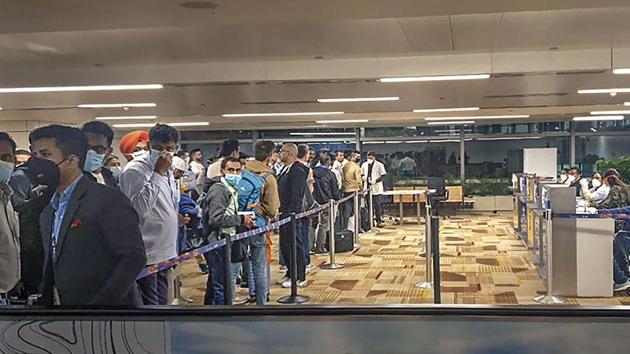
If a passenger arrives from one of the 12 countries designated hot spots of the disease, which has claimed roughly 4,000 lives worldwide, they are segregated on arrival, taken to a different building where they are screened for abnormally high body temperature and other symptoms.
The segregation is done, according to orders by the Airports Authority of India, to minimise possibility of the disease spreading at the airport. The 12 countries are China, South Korea, Japan, Italy, Iran, Singapore, Thailand, Malaysia, Hong Kong, France, Germany and Spain.
Also Read: India suspends most visas for foreigners to prevent coronavirus spread
“When we landed in Terminal 3 in Delhi from the United States, buses took us to a building where many passengers had formed a line for the screening. It took us more than an hour to clear it because of the long queues,” said Sarita Malhotra, who travelled with her husband. After the screening, passengers were allowed to proceed to the usual immigration counters and then the baggage conveyor belts, she said.
Others said the experience was smooth. “The staff was receptive and professional, with the doctors making the experience as pleasant as possible,” tweeted Sherbir Panag, a lawyer.
{{/usCountry}}Others said the experience was smooth. “The staff was receptive and professional, with the doctors making the experience as pleasant as possible,” tweeted Sherbir Panag, a lawyer.
{{/usCountry}}According to the rules, incoming passengers have to also submit, in duplicate, a self-declaration health form that specifies their names and addresses, passport, flight and seat numbers and the places they have visited. These forms were distributed by some airlines on the flight back to India, but others complained they were delayed because they didn’t know about the form, or that it had to be filled in duplicate.
“It would be great to receive the forms in flight so that they can be filled out, as opposed to a last-minute scramble,” said Panag.
Screening for outbound passengers wasn’t being enforced in airports in the United States and United Kingdom. “I didn’t have any screening or problems boarding my India-bound flight,” said Amit, a 23-year-old student from London. At major airports,such as London and New York, some passengers reported that no containment protocol was visible.
The US is mandatorily screening passengers from hotspots such as China, Italy and South Korea.
Some passengers have complained of long delays, and some people slipping out of the screening cordon, but civil aviation minister Hardeep Puri dismissed these claims.
In a series of tweets, he said only two such complaints had been received: One by a passenger in Chennai who arrived before universal screening was enforced, and another in Delhi who had walked through thermal sensors without realising it. “Let me assure you that passengers travelling on international flights are now being universally screened upon their arrival,” he said.