
 E-Paper



Sonam Wangchuk’s wife moves Delhi HC to transfer activist from Safdarjung Hospital, cites lack of trust
Safdarjung Hospital stated on Sunday that Wangchuk is receiving the "required medical intervention" and that he requires continuous medical care.

 Prefer HTon Google


Activist Sonam Wangchuk’s wife, Gitanjali Agmo, has moved the Delhi High Court seeking his transfer from Safdarjung Hospital to a private medical facility, alleging a lack of trust in the treatment being provided and calling his continued confinement unconstitutional.
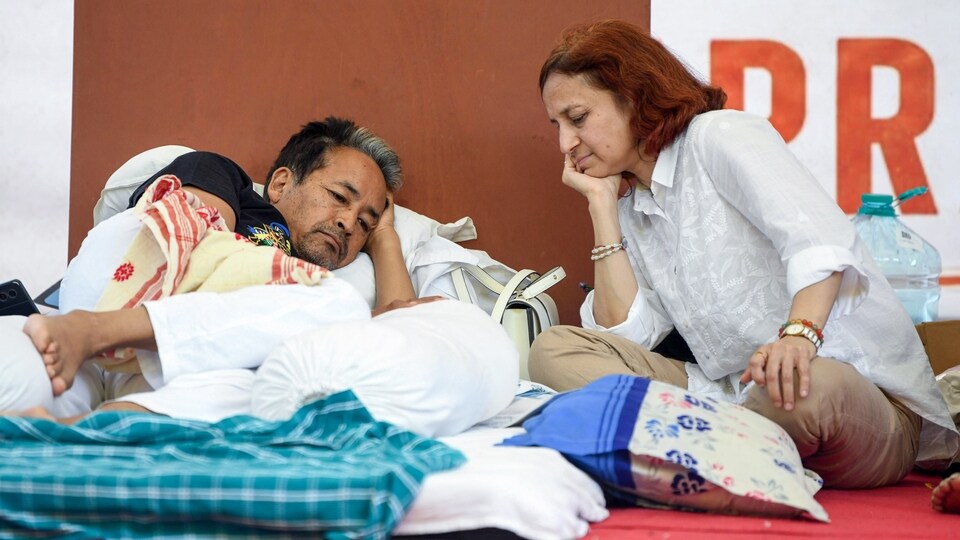
Wangchuk, who has been on an indefinite hunger strike at Jantar Mantar for 21 days over irregularities in national examinations, was taken to Safdarjung Hospital by Delhi Police on Saturday morning. While the police said the move was aimed at monitoring his health in line with court directions, opposition parties accused the Centre of using force against a peaceful protest and questioned the timing of the action, a day after the appointment of a new Delhi police commissioner. The BJP defended the police action, saying it was taken to protect Wangchuk’s health.
Follow here for live updates on Sonam Wangchuk's health and hunger strike.
Supporters said Wangchuk was forcibly removed, triggering a commotion at the protest site, during which they were allegedly lathi-charged and Cockroach Janata Party (CJP) founder Abhijeet Dipke was briefly detained.
Wangchuk’s wife has sought an urgent hearing today itself, people aware of the development said.
In her petition filed through advocate Bahuli Sharma, Gitanjali has also sought a declaration that her husband’s continued confinement at Safdarjung Hospital is unconstitutional, asserting that at the time of his removal from the protest site, his vital parameters were stable and he was under continuous medical supervision by qualified healthcare professionals.
Also Read | 'India's 2nd freedom movement': Sonam Wangchuk's message from 'illegal detention' at Safdarjung
The petition said that there was no medical emergency or other circumstance warranting such abrupt and coercive intervention, and that the forcible removal was neither medically necessary nor legally justified. The action, it said, amounted to a manifest infringement of Wangchuk’s fundamental rights.
Gitanjali further said that she was not informed by the cops about the forcible removal, despite her husband’s categorical request, and found out about the incident through a volunteer at the protest site. It added that the hospital informed her that his potassium level had fallen to 2.9, but refused to provide the test report. However, after a 10.5-hour delay in releasing a blood sample, an independent test reportedly showed a higher level of 3.6. These discrepancies, she said, are proof of mala fide conduct by the authorities.
“When the Petitioner reached the hospital- she was informed by the doctors of the Respondent hospital that Shri Sonam Wangchuk’s potassium levels had dropped to 2.9 mg as on the morning of 18.07.2026 which warranted the urgent medical intervention. While the report was shown to the Petitioner- no copies of the report were provided to the Petitioner. The Petitioner demanded copies of the report, and informed the Respondent authorities that blood work from the previous day i.e. 17.07.2026 had recorded Shri Sonam Wangchuk’s potassium levels as 4.3 mg at 4:17 PM. Alarmed by the sudden discrepancy in levels- the Petitioner, at 12:00PM, requested the hospital for a blood sample of Shri Sonam Wangchuk to conduct a re-test from a different hospital,” the petition said.
Also Read | Delhi Police ‘won’t allow' CJP's Parliament march on July 20, calls it ‘illegal’
It added, “The Respondents furnished the blood sample to the Petitioner at 10:30 PM- after an unexplained delay of nearly 10.5 hours. As apprehended by the Petitioner, results of the tests conducted on these samples indicate a potassium level of 3.6 mg, much higher than the earlier disclosed level of 2.9 mg. This clearly reveals a significant discrepancy in test results provided by the Respondents as compared to the tests conducted by an independent agency at the behest of the Petitioner. The mala fide conduct of the Respondents is thus evident from the results.”
It also said that despite repeated written representations, the authorities have refused her request to discharge her husband from the said hospital and seek treatment at a hospital of his family’s choice.
Such clandestine and opaque nature of the alleged medical intervention, his admission in the hospital without access to his legal counsel or doctors who had been examining him for the last 20 days, in the absence of any lawful order of arrest or detention, is wholly arbitrary and constitutes a serious infringement of his fundamental rights, the petition said.
“Further, the Petitioner was arbitrarily denied permission to take her phone or any device while meeting her husband. Further, it is submitted that despite these repeated requests, the Respondents have disclosed only selective information and refused the family’s request to shift him to another hospital, thereby preventing any independent verification of his medical condition,” the petition said.


