
 E-Paper



Mamata Banerjee vs Suvendu Adhikari: Heavyweights gear up for round 2 in Bengal elections 2026
Once part of the same party - the TMC – Mamata Banerjee and Suvendu Adhikari are now rivals with the latter's dramatic shift to the BJP in 2020.

 Prefer HTon Google


West Bengal politics and elections there cannot be discussed without the mention of a rivalry that is possibly one of the biggest political friends-turning-foes stories across states – chief minister and Trinamool Congress supremo Mamata Banerjee versus Leader of Opposition and Bharatiya Janata Party (BJP) leader Suvendu Adhikari.
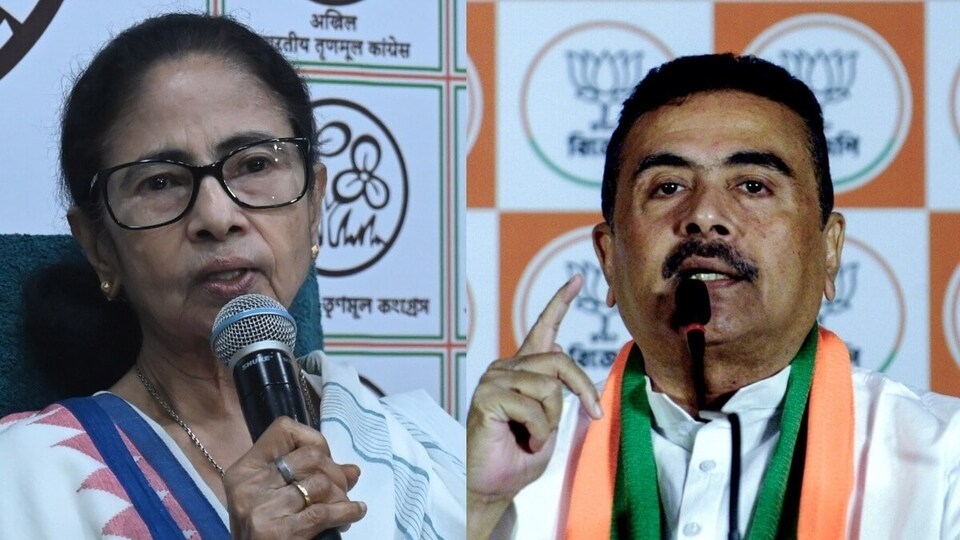
What began as a mentor-protégé relationship inside the Trinamool Congress has transformed into one of Indian politics’ most personal and symbolic electoral battles, a contest rooted in rebellion, betrayal and unfinished political business.
Mamata vs Suvendu rivalry
Once part of the same party and considered close to each other - the TMC – Mamata Banerjee and Suvendu Adhikari are now rivals with the latter's dramatic shift to the BJP in 2020.
The story of Mamata Banerjee and Suvendu Adhikari cannot be told without Nandigram, the epicentre of Bengal’s political transformation.
Mamata and Suvendu's Nandigram time
In 2007, during the anti-land acquisition movement against the Left Front government, Suvendu Adhikari played a pivotal role and emerged as one of Mamata Banerjee’s most trusted organisers.
The Nandigram agitation helped propel the Trinamool Congress to power in 2011, ending 34 years of Left rule in West Bengal.
Adhikari rose rapidly within the party – serving as minister in multiple portfolios and widely seen as Mamata’s key strategist in rural Bengal. For years, he was considered the party’s organisational backbone in East Midnapore and one of Banerjee’s closest lieutenants.
But the relationship began fraying around 2019 amid internal power struggles and accusations of sidelining. In 2020, Adhikari dramatically defected to the BJP – transforming himself overnight from Mamata’s political general into her chief rival.
2021 elections, the turning point
The rivalry that started in 2020 reached its peak during the 2021 assembly elections when Mamata Banerjee chose to contest from Nandigram – a Suvendu stronghold.
The contest went down to the wire before Adhikari defeated the sitting chief minister by a narrow margin, one of the biggest symbolic upsets in Bengal politics despite the TMC winning the election overall otherwise.
Despite the TMC poll win, Nandigram loss forced Banerjee to temporarily remain outside the Assembly until she later won a bypoll from Bhabanipur or Bhowanipore.
The result permanently altered Bengal’s political narrative: the former aide had successfully challenged his political mentor on her own ideological turf.
In the years that followed, Mamata and Suvendu exchanged barbs over issues the TMC and BJP clashed with each other, including law and order, political violence and the voter fraud allegations.
In the most recent flashpoint, the TMC has sought the immediate removal of the returning officer for the Bhabanipur assembly constituency, alleging he has proximity with Suvendu Adhikari.
2026 elections: Bout 2.0 in Bhabanipur
Five years later, the rivalry has entered a new phase. In the ongoing 2026 Assembly elections, Adhikari has taken the fight directly to Banerjee’s urban bastion – Bhabanipur – making the constituency one of the most watched contest in the state.
The BJP in March released its first list of 144 candidates for the West Bengal assembly polls, fielding leader Suvendu Adhikari from Mamata Banerjee’s current seat of Bhawanipore in south Kolkata as well as from his traditional bastion of Nandigram where he defeated the chief minister in 2021.
Voting for West Bengal assembly elections will take place in two phases, first on April 23 and second on April 29. The counting of votes is scheduled for May 4, alongside that of Assam, Kerala, Tamil Nadu and Puducherry.
Mamata Banerjee has returned to her familiar campaign style — positioning herself as Bengal’s protector against what she describes as external political interference and electoral manipulation.
Recent speeches have accused the BJP of importing supporters and attempting to influence voter rolls ahead of polling.
Adhikari, meanwhile, has framed the election as a battle for political change, leveraging his 2021 victory as proof that Banerjee’s dominance can be challenged.
As West Bengal heads to the polls, the election once again circles back to a relationship that reshaped the state’s politics: a leader and her former lieutenant, now locked in a rivalry that defines the present – and possibly the future – of Bengal.


