United Nations Secretary General Antonio Guterres on Sunday acknowledged that developing countries around the world needed “massive international support” to be able to implement their sustainable development goals (SDGs), as he called for multilateral development banks to look at new business models to mobilise private investment and concessional funding for developing countries.
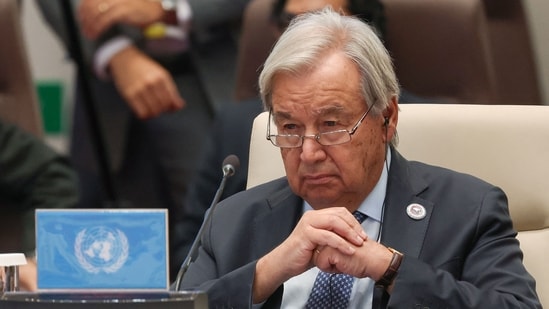
Speaking on the second and final day of the Brics Summit, Guterres stressed that the 1.5°Celsius will be surpassed soon and asked for the overshoot to be made as small and short as possible, by “over-delivering” on national climate plans, while focusing on climate justice. He also stressed on the need for world peace.
ALSO READ | After BRICS push for ‘greater role’, US economist backs India for UNSC seat: ‘No country has stronger claim’
“International financial architecture must be reformed giving higher participation and influence to developing in the decision-making processes in order to guarantee more equity and justice, and to address historical injustices. Multilateral development banks must also become bigger, better and bolder, with a new business model to mobilise massive private investment and expand concessional funding to developing countries,” Guterres said, calling for countries to work towards development-oriented debt architecture and effective debt relief mechanisms.
Deep Dive
Why does UN Secretary General Antonio Guterres emphasize the need for international support for developing countries' SDGs?
How can multilateral development banks better support developing countries according to Guterres at the Brics Summit?
What are the key pillars of action proposed by Guterres for inclusive global growth?
The four pillars of action he listed for shaping inclusive global growth included financing, technology (including AI), climate justice, and peace.
{{/usCountry}}The four pillars of action he listed for shaping inclusive global growth included financing, technology (including AI), climate justice, and peace.
{{/usCountry}}Flagging climate justice as an important global agenda, the UN secretary general said the impacts of climate change were already being seen, with scorching heat, devastating glacier melt, raging wildfires and devastating floods all a preview.
ALSO READ | ‘Weaponisation of critical minerals…’: PM Modi’s BRICS message, with Xi, Putin by his side
“Scientists confirm we will soon breach the 1.5 degree limit. We must make this overshoot as small and short as possible. We need an overshoot of ambition: accelerating the transition from fossil fuels to renewables, slashing methane, protecting nature,” he said, underlining that every country needed to do more.
“Over-delivering on national climate plans, scaling up renewables…and driving investment towards developing countries. Climate justice also means protecting people from escalating impacts,” he said. Developed countries needed to keep their promises, including COP 29’s agreement, where developed countries agreed to pledge $300 billion a year to developing countries; and the need globally for early warnings for every person, he added.
ALSO READ | China's Xi Jinping calls for stronger Global South ties, puts forth 5 initiatives at BRICS Summit
On global conflicts, Guterres said states needed to respect their obligations under the UN Charter and international law — including the principles of sovereign equality, respect for territorial integrity and political independence of states.
“From Gaza, to the broader crisis in the Middle East, to Ukraine, Sudan and beyond, our world needs peace. As we move irreversibly to a multipolar world, all countries must work to strengthen and safeguard a multilateral system that delivers for all with the United Nations at its centre,” he said.
The secretary general also said while Artificial intelligence (AI) can compress decades of development into years, but its power currently sat with a few companies, in a few countries – asking for similar opportunities to be given to developing countries too.
ALSO READ | BRICS declaration: China, Russia back India, Brazil’s aspirations for greater UN role
“The Global Network for AI capacity building and the Global Fund for AI aim to close that gap — and I ask you to fully back them,” he added.
On Saturday, BRICS countries had adopted the 45-page ‘New Delhi declaration’ which stressed on addressing root causes of conflict and resolving disputes through dialogue and diplomacy. It had also expressed “deep concern over the continued escalation of tensions” in the West Asia region.