Ahead of the crucial 2027 state assembly elections, Uttar Pradesh's political battleground is growing tense as Bahujan Samaj Party's internal friction is playing out before the public's eyes. Days after removing her nephew Akash Anand from his organisational post, party supremo Mayawati on Wednesday set a 'sanyas' condition for his responsibilities to be restored.
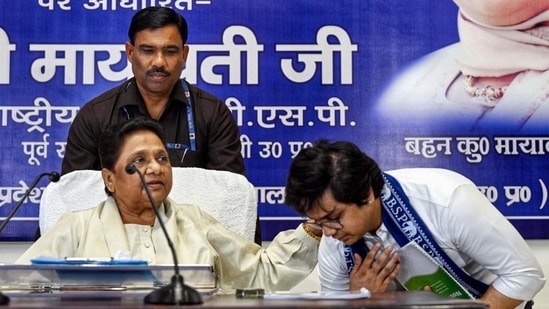
In a post on X, Mayawati issued an ultimatum to former Rajya Sabha MP Ashok Siddharth, directly linking the political future of Akash Anand to Siddharth's exit from politics.
The former UP chief minister said that Akash Anand could return to an active role in BSP only if his father-in-law, Ashok Siddharth, gives up his political ambitions and retires.
Also Read | After removing nephew Akash Anand, Mayawati appoints his brother Ishan to key BSP post
‘Prioritised his personal and familial interests…’
Mayawati accused Siddharth of prioritising his personal and family ambitions over the party's mission.
"And against those who try even slightly to create obstacles in this path, disciplinary actions, etc., are also being taken, a prominent example of which is Shri Ashok Siddharth, who was once a Rajya Sabha MP of the BSP," she wrote in the post.
"The party gave him not just one but several opportunities to mend his ways, but he prioritised his personal and familial interests and ambitions over the BSP's mission, the consequences of which he himself, along with his son-in-law Shri Akash Anand, has had to bear," the BSP chief added.
{{/usCountry}}"The party gave him not just one but several opportunities to mend his ways, but he prioritised his personal and familial interests and ambitions over the BSP's mission, the consequences of which he himself, along with his son-in-law Shri Akash Anand, has had to bear," the BSP chief added.
{{/usCountry}}Also Read | Akash Anand’s roller-coaster ride continues, Mayawati removes him from key BSP post again
Mayawati stated that Siddharth had "never truly cared" about Anand or the BSP movement because of his personal interests.
Furthermore, she added that Siddharth has an opportunity to put aside his political ambitions and retire completely from politics in the interest of the BSP, the movement, his family, and his son-in-law.
“Aise mein BSP party wa movement ke hit ke saath-saath khud unke parivaar evam apne daamaad Shri Akash Anand ke bhavishya ko dhyan mein rakhkar Shri Ashok Siddharth ke paas abhi bhi mauka hai ki ve apni raajneetik mahatvaakaanksha ko tyaag kar wa niji swarth aadi se upar uthkar raajneeti se poori tarah se sanyaas le lein. (In such a situation, keeping in mind the interests of the BSP Party and Movement, as well as his own family and the future of his son-in-law Shri Akash Anand, Shri Ashok Siddharth still has the opportunity to renounce his political ambitions, rise above personal interests, etc., and completely retire from politics.),” she stated in the post.
"Only then will Shri Akash Anand be able to work freely in the party, and only then will the party sympathetically consider restoring his responsibilities so that he can play an active role in the party—this is the general consensus in the party," she said.
Also Read | BSP to go solo in Punjab, U’khand, UP, says Mayawati
UP, Punjab, Uttarakhand elections
In the post, she noted that the assembly elections in the three states are approaching and described them as particularly important for the BSP and the Bahujan movement.
She also called on party workers, office-bearers, supporters and well-wishers to work with full dedication.
Seeking support from people across communities, she said that the BSP was facing challenges from opposition parties and "casteist elements".
Also Read | Mayawati removes nephew from key BSP post, believes he ‘requires further maturity’
Akash Anand and the BSP
Mayawati's latest condition for Anand's return comes just days after she removed him from the post of BSP national coordinator during a meeting of party office-bearers.
The organisational structure of the BSP is divided into three sectors: two sectors comprise other states, while the third consists of UP and Uttarakhand, as HT reported earlier.