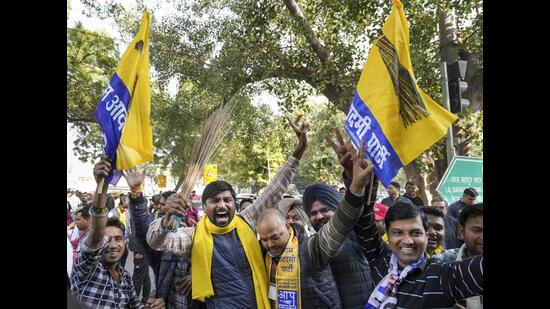
134 Aam Aadmi Party (AAP), 104 Bharatiya Janata Party (BJP). The results of the 2022 Municipal Corporation of Delhi (MCD) elections on Wednesday were remarkable for several reasons — the AAP, which was expected to win easily (the lowest tally projected by exit polls was 146), ended up with a fight on its hands; the BJP did far better than what even its most optimistic supporters expected it to; and some of the Congress’s traditional voters who had deserted it over the past decade, including Muslims, appeared to return to the party.
But at the end of the day, only the outcome matters in elections.
And they read, 134 AAP, 104 BJP.
“I congratulate the people of Delhi for this win and thank them for bringing change. We have fulfilled the responsibilities that the people of Delhi gave us. I am indebted to you for believing in me,” Delhi chief minister and AAP chief Arvind Kejriwal said, seeking the blessings of all, including Prime Minister Narendra Modi, in running the civic body.
The factors behind the numbers of the 2022 MCD elections were interesting. The definition of wards, and gerrymandering, may have played a role. The BJP’s targeting of AAP over a series of scandals — real or imagined, the courts will decide — may also have played a role. As may have the campaigning strategies of the three parties — the AAP couldn’t use Kejriwal as much as it may have liked to; the BJP didn’t use its trump card, PM Modi, at all; and the Congress’s heavyweights simply chose to stay away.
While the BJP conceded defeat, the party’s Delhi unit chief, Adesh Gupta, said, “People of Delhi have given us almost 40% vote share along with 104 wards and responsibility to work as a strong opposition. We will constructively keep raising the issues concerning the general public.”
{{/usCountry}}While the BJP conceded defeat, the party’s Delhi unit chief, Adesh Gupta, said, “People of Delhi have given us almost 40% vote share along with 104 wards and responsibility to work as a strong opposition. We will constructively keep raising the issues concerning the general public.”
{{/usCountry}}But at the end of the day, only the numbers matter in elections.
And they read, 134 AAP, 104 BJP.
There is no anti-defection law in corporations, and the AAP’s majority (just eight over the majority mark of 126) may appear slim given the BJP’s proven ability, showcased across the years and the states from Karnataka to Madhya Pradesh to Maharashtra, to work the numbers to its advantage, but the AAP’s seat tally is 18 over the tally of all others (BJP, Congress and Independents) together, and 31 more than the BJP’s. It’s a gap that’s evident in the numbers.
And they read, 134 AAP, 104 BJP.
The vote share numbers of the MCD elections indicate the surprising nature and intensity of a contest that was expected to be bipolar. The AAP ended up with 42%, the BJP, with 39%, and the Congress with 12%. It may not make much sense to extrapolate these numbers on to even state elections. The AAP won a 54% vote share in the 2015 assembly elections and came to power with 67 seats (in an assembly of 70), but received only 26% of the votes and 49 seats across the three MCDs (total seats: 272) in 2017.
“The BJP’s vote share has remained largely stable in the city. It’s the Congress that’s been the variable — it did better in 2017 but as it faded, the AAP picked up a lot of its votes. This was an unusual MCD election that played out more like a state election because local-level ties and issues didn’t appear to have mattered as much,” said political scientist Neelanjan Sircar, a senior fellow at the Centre for Policy Research.
But at the end of the day, and especially in a first-past-the-post system, only seats matter.
And they read, 134 AAP, 104 BJP.
The AAP now gets its own version of a double-engine (a term popularised by the BJP to advertise the benefits of having the same party in power in a state and at the Centre) government, but will continue to have to deal with Delhi’s unique governance structure that still gives the lieutenant governor (L-G), a Union government-appointee significant (and veto) powers. The L-G gets to appoint 10 nominated members to MCD, but they will not be voting in the mayoral election that will soon follow.
The AAP, then, is likely to end up with its mayor, and also its person as the head of the standing committee of MCD, giving it control over the body’s ₹15,200 crore budget, and a critical role to play in the life of the Capital’s 20 million residents.
“Heartfelt gratitude to the people of Delhi for trusting Aam Aadmi Party in Delhi MCD. By defeating the world’s biggest and most negative party, the people of Delhi have made a hardcore honest and working Arvind Kejriwalji win,” said deputy chief minister Manish Sisodia.