Prime Minister Narendra Modi on Friday said the Shanghai Cooperation Organisation (SCO) should create trusted and resilient supply chains to bolster economic recovery and overcome impediments created by the Covid-19 pandemic and the Ukraine crisis.
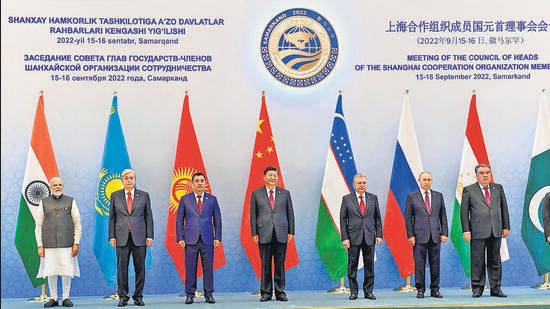
Addressing the SCO Summit in Samarkand, Modi said members of the world’s largest regional grouping should give each other transit rights to help forge better regional connectivity. Modi’s interventions at two sessions of the summit focused on the need for better regional connectivity to drive trade and economic cooperation, including greater use of the India-developed Chabahar port in Iran and the International North South Transport Corridor (INSTC).
Modi also emphasised the need for enhanced cooperation to fight terrorism across the region, and said the SCO could play an important role in such efforts through its Regional Anti-Terrorist Structure (RATS). The SCO agreed to work on a unified list of extremist, separatist and terrorist organisations banned by the member states, and all members “very clear in recognising the threat that this challenge poses to our region”, foreign secretary Vinay Kwatra told a news briefing after the summit.
The Prime Minister said the SCO Summit was being held against the backdrop of a challenging regional and global situation, and the whole world was grappling with the challenge of economic recovery after the pandemic. The SCO’s role is very important in such circumstances as its member states account for almost 30% of the global GDP and 40% of the world’s population.
{{/usCountry}}The Prime Minister said the SCO Summit was being held against the backdrop of a challenging regional and global situation, and the whole world was grappling with the challenge of economic recovery after the pandemic. The SCO’s role is very important in such circumstances as its member states account for almost 30% of the global GDP and 40% of the world’s population.
{{/usCountry}}“India supports increased cooperation and mutual trust between the SCO member states,” Modi said, speaking in Hindi.
“The pandemic and the Ukraine crisis have created several impediments for global supply chains and the whole world is facing an unprecedented food and energy crisis. In our region, SCO should try to create trusted, resilient and diversified supply chains. For this, we need better connectivity and it is also important that all of us give transit rights to each other,” he said.
India is making progress in its efforts to become a manufacturing hub, and the country’s economy is expected to grow by 7.5% this year, which will be the highest among the world’s biggest economies, Modi said.
The people-centric governance model of India makes appropriate use of technology and the government backs innovation in every sector. There are more than 70,000 start-ups in India, including more than 100 unicorns, and the country’s expertise in this field can be used to help other SCO members, he said.
Referring to the big challenge of ensuring food security for people around the world, Modi said a possible solution could be efforts to encourage the cultivation and consumption of millets, which he described as a “superfood” that has been grown in the SCO states and many other parts of world for long.
He said the UN will observe the international year of millets in 2023, and SCO should discuss holding a “millet food festival”.
Pointing to India’s emergence as a centre for medical and wellness tourism, Modi said the World Health Organization (WHO) had established a global centre for traditional medicines in Gujarat this year. This is the first and only such global centre under WHO and SCO should increase cooperation on traditional medicines, he said.
Modi made his interventions at a restricted session attended by the leaders of the eight member states – China, India, Kazakhstan, Kyrgyzstan, Pakistan, Russia, Tajikistan and Uzbekistan – and an extended session attended by the leaders of the member states and leaders of observer states such as Turkey and other nations invited by Uzbekistan, the host of the summit.
Kwatra said the PM shared India’s perspective on the regional and global situation and issues of regional peace and security, including the situation in Afghanistan. Modi also emphasised the centrality of the Central Asian states in SCO and welcomed the inclusion of Iran as a new member state.
Modi supported the further expansion of the SCO and said the close civilisational ties between the member states could be the base for building substantive cooperation in trade and economy as well as humanitarian and development partnerships.
The SCO approved the creation of a special working group on start-ups and innovation with India as the permanent chair. It also approved an Indian initiative for setting up an expert working group on traditional medicine and endorsed Varanasi as the first “tourist and cultural capital” of SCO.
Besides the Samarkand Declaration outlining the future plans of the grouping, the summit adopted a statement on the response to climate change at India’s initiative, Kwatra said.