E-Paper



Modi re-emphasises swadeshi as he inaugurates Maruti’s EV, battery plant
Prime Minister Narendra Modi called the EV production and battery manufacturing plant a new chapter and a big leap towards the goal of “Make in India, Make for the World”

 Prefer HTon Google


Prime Minister Narendra Modi on Tuesday re-emphasised swadeshi at the inauguration of Maruti Suzuki India’s e-Vitara electric vehicle (EV) and battery manufacturing plant in Gujarat’s Hansalpur, emphasising that the source of capital matters less than ensuring the Indian workforce drives the work.
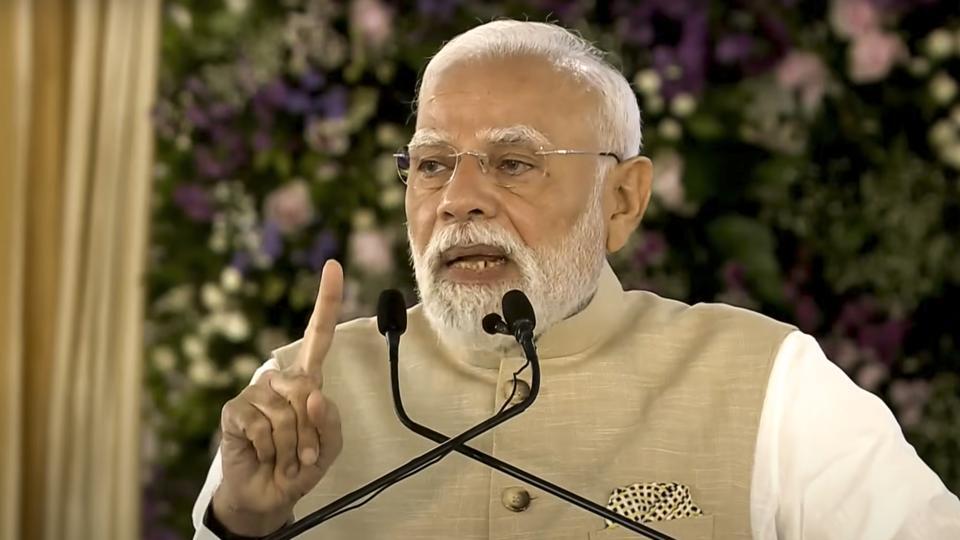
“My definition of swadeshi is simple. I do not have any concern about whose money it is—whether it is dollars or pounds, or where it comes from.... What matters is that the sweat and the hard work should be Indian,” Modi said at the inauguration, a day before the US imposes an additional 25% tariff on Indian goods from Wednesday.
Indian exports will face duties of up to 50%. It is among the highest the US has imposed. President Donald Trump announced the extra tariffs over India’s purchases of Russian oil.
Modi on Monday asked businessmen to display “swadeshi only” boards outside their shops as he reiterated India would not compromise on the interests of farmers and small businesses against the backdrop of the imposition of the additional US tariffs.
Modi called the EV production and battery manufacturing plant a new chapter and a big leap towards the goal of “Make in India, Make for the World”. He said EVs made in India will be exported to 100 countries. “...hybrid battery electrolyte manufacturing is also starting,” Modi said.
Modi highlighted the transformation of India-Japan relations. He said Suzuki Japan is manufacturing in India, and the cars are exported to Japan. Modi added that this demonstrates the strong bonding between the nations and reflects the confidence of global companies in India.
“Maruti Suzuki is the largest car exporter in India today. In a way, Maruti Suzuki has become the brand ambassador of Make in India. Now the company plans to replicate this success in the EV sector. Vehicles running in several countries will proudly bear the ‘Made in India’ tag.”
Modi noted the venture would give a new direction to the India-Japan friendship as he spoke about Maruti’s journey in India. “I am happy that Maruti Suzuki is entering a new stage. In the coming days, it will fly to new heights and gain new levels.”
Modi referred to the project’s origins in his tenure as Gujarat chief minister. “In 2012, when I was the chief minister....we allotted land in Hansalpur to Maruti Suzuki…we had a vision of Atma Nirbhar Bharat [self-sufficient India] and ‘Make in India’ even then.”
He remembered the late Japanese businessman Osamu Suzuki and said the government conferred the Padma Vibhushan, the second-highest civilian award, upon him. Modi said he is pleased to witness the expansion of Suzuki’s vision for Maruti Suzuki India.
Modi said he is visiting Japan next week and added that the relationship between the two countries goes far beyond diplomatic ties and is rooted in culture and mutual trust. He added that the major initiative to realise the industrial potential of the India-Japan partnership began in Gujarat. Modi noted Japan was a key partner when the “Vibrant Gujarat” Summit was launched 20 years ago.
Modi said India has the strength of democracy and the demography. “India also has a vast pool of skilled workforce, creating a win-win situation for every partner.” Modi recalled that in 2017, the foundation of the battery plant was laid with this vision. He said three Japanese companies will jointly manufacture battery cells in India for the first time. He added that this localisation will empower India’s self-reliance.
Modi said this will accelerate the growth of the hybrid EV sector. He noted that EVs were previously seen only as alternatives, though he had always held that they were the solution to problems. “Last year, during my Singapore visit, I realised how our old cars, old ambulances, can be converted to EVs. Maruti Suzuki has accepted the challenge and developed a working prototype in just six months,” he said.
Modi added that they align perfectly with the PM E-DRIVE scheme. Modi said that under this ₹11,000 crore scheme, a dedicated budget has been allocated for e-ambulances. Modi said the hybrid EVs will help reduce pollution and offer a viable option to transform old vehicles. He added that preparations for this transformation were initiated when he became the Prime Minister in 2014. Modi referred to the launch of the “Make in India” campaign and the creation of a conducive environment for global and domestic manufacturers.
Modi said India is working to make its manufacturing sector efficient and globally competitive. He spoke about India’s industrial transformation over the past decade. Modi said while “the world is struggling with supply chain disruption,” the policies implemented since 2014, including Make in India, globally competitive industrial corridors, plug-and-play infrastructure, and production-linked incentives, are now proving their worth.
He said the electronic production has risen by 500% and mobile phone production by 2700% compared to 2014. Modi added that the defense sector growth has exceeded 200%. Modi said clean energy and clean mobility represent India’s future. He emphasised that through such efforts, India is rapidly emerging as a reliable hub for clean energy and clean mobility.
Modi said this success is motivating all states across India, and a healthy competition has emerged among states regarding reforms and investment, benefiting the entire nation. He urged the states to come up with pro-development policies and reforms with enhanced ease of doing business facilities to attract global investors.“India will not stop here. In sectors where India has performed well, the goal is to achieve even greater excellence,” said Modi. He underlined that the government is prioritising Mission Manufacturing to drive this progress.
He highlighted that India’s focus will now shift towards futuristic industries. Modi said the semiconductor sector is taking off, with six plants set to be established. Modi affirmed the commitment to advance semiconductor manufacturing. Modi said the government is attentive to the challenges the auto industry faces due to shortages of rare earth magnets. He said the National Critical Mineral Mission was launched to strengthen capabilities.