
 E-Paper



PM Modi, Germany's Scholz vow to deepen ties
German Chancellor Olaf Scholz described India as a “central part” of Germany’s plans for Asia, and said that the Asian nation’s economic and population growth made it a key player for tackling global climate change and its consequences.

 Prefer HTon Google


New Delhi: India and Germany on Monday launched a Green and Sustainable Development Partnership by which Berlin will provide €10 billion until 2030 to help implement New Delhi’s climate transition plans, and decided to sign a migration and mobility agreement that will benefit students and professionals from the two countries.
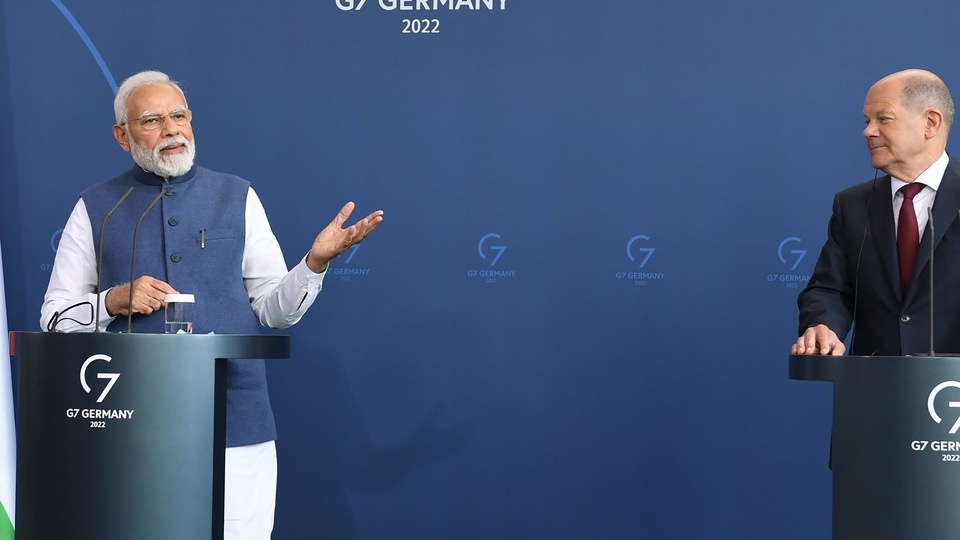
These were the major outcomes of the India-Germany inter-governmental consultations (IGC) jointly chaired by Prime Minister Narendra Modi and Chancellor Olaf Scholz in Berlin at the start of the Modi’s three-nation European tour. The two sides signed seven more agreements, including one on joint implementation of development projects in third countries, and another on establishing a renewable energy partnership.
Modi said at a joint media interaction with Scholz the IGC gave a new direction to the bilateral partnership and provided important guidance to cooperation in energy and environment.
“Today we are launching the India-Germany Green and Sustainable Development Partnership. India has shown to the world that green and sustainable growth is an article of faith for us by raising its climate ambition [at COP26] in Glasgow,” Modi said, speaking in Hindi.
“Under this new partnership, Germany has decided to support India’s green growth plans with an additional development assistance of €10 billion by 2030. For this, I thank Germany and Chancellor Scholz.”
Scholz described India as a “central part” of Germany’s plans for Asia, and said the country’s economic and population growth made it a key player for tackling global climate change and its consequences. “Look at the impact the current heat wave in India has had on its population – that is an indication of the impact climate change is having and that we have to do what we can to stop it,” he said, speaking in German.
The Green and Sustainable Development Partnership will intensify bilateral, triangular and multilateral cooperation and link it with the implementation of commitments under the Paris Agreement and Sustainable Development Goals (SDGs), according to a joint statement. Germany will strengthen its financial and technical cooperation and other aid to India with a long-term goal of providing €10 billion in new and additional commitments till 2030.
This funding will support the achievement of climate action goals, promote bilateral research and development and encourage private investment. Both sides will create a ministerial mechanism to provide political direction to this partnership, which will include existing initiatives in climate action, sustainable development, energy transition and development cooperation.
The two sides also agreed to launch a renewable energy partnership focused on innovative solar energy and other renewables, including challenges related to electricity grids and storage, and to create a Green Hydrogen Task Force.
Both sides welcomed the finalisation of negotiations on a bilateral agreement for a comprehensive migration and mobility partnership, as reflected by the initialling of the draft agreement. “They agreed to take action to swiftly sign the agreement and bring it into force. They highlighted the importance of this agreement in facilitating two-way mobility of students, professional and researchers as well as addressing the challenges of illegal migration,” the joint statement said.
Scholz said the proposed migration and mobility agreement will allow both sides to benefit from the “enormous potential of migration and skilled labour”. He added: “This goes to show that our relationship is not only broad and intensive but it is also based on a deep sense of trust.”
More than 1,800 German companies that are active in India have recognised the country’s potential and have helped create hundreds of thousands of jobs, he noted.
“Our companies are well aware of the locational advantages of India – a big market, a high potential for growth and an impressive ability to innovate. The higher education and science sector too is a good indicator for the ever closer integration of both our countries,” he said.
Scholz further noted that more than 7,000 Indian students are currently enrolled in German universities and higher educational institutions, and added: “They are very welcome, above and beyond studies in Germany.”
Modi said many countries had benefited from India’s skilled workers and professionals and the migration and mobility agreement with Germany will facilitate movement between the two sides at a time when India is witnessing the fastest growth in the post-Covid era as compared to other developing economies.
“We are confident that India will become an important pillar of the global recovery. Recently we signed trade agreements with the UAE and Australia in a very short span of time. We remain committed to early progress in FTA negotiations with the EU as well,” he added.
The Prime Minister also referred to the agreement on implementing joint development projects in third countries and said these ventures will gain from India and Germany’s long experience in development cooperation in other countries. “Our collaboration will provide an alternative to transparent and sustainable development projects for the developing world,” he said.
The other agreements signed by the two sides covered the exchange and mutual protection of classified information and establishing a direct encrypted connection between the foreign ministries, cooperation in advanced training of corporate executives and junior executives from India, agro-ecology, and forest landscape restoration.
Both sides expressed serious concern about the humanitarian situation in Afghanistan, resurgence of violence, systemic violations of human rights and hampered access of girls and women to education. They reiterated their support for a peaceful, secure and stable Afghanistan and also strongly condemned terrorism in all forms, including “any use of terrorist proxies and cross-border terrorism”.
“They called upon all countries to work towards rooting out terrorist safe havens and infrastructure, disrupting terrorist networks and financing in accordance with international law, including international humanitarian law,” the joint statement said.
Earlier, Modi was accorded a guard of honour and received by Scholz on his arrival at the federal chancellery. Besides the IGC, Modi and Scholz held a bilateral meeting that covered key areas of bilateral cooperation and regional and global developments, including the Ukraine war.



