In the biggest electoral victory ever achieved by a party in Gujarat’s history, the Bharatiya Janata Party (BJP), led by Prime Minister Narendra Modi, set a new benchmark on Thursday by winning 156 seats in the 182-member state assembly. As the BJP celebrated its unprecedented seventh successive electoral victory, the Congress shrank to its lowest tally in the state with just 17 seats, less than a tenth of the strength of the assembly.
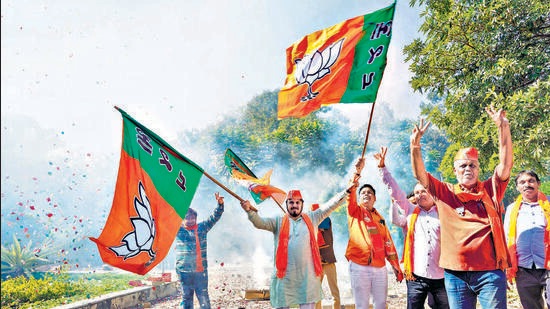
Bhupendra Patel, a low-key local leader from Ahmedabad who took charge as chief minister in 2021, will remain the chief minister, but the BJP’s electoral success was driven almost entirely by Modi’s campaign and home minister Amit Shah’s electoral management in their home state.
While reinforcing the BJP’s dominance — the party bagged 52.5% of the vote share, a jump from the 49.1% it got in 2017 — the verdict came as a rude shock for the Congress. In elections marked by any sustained campaign by the Congress leadership, the party was able to secure only 27.3% of the votes, a 14 percentage point dip from its vote share in 2017. The Aam Aadmi Party (AAP), a new entrant in the state, was able to win only five seats despite a high-octane campaign but grabbed a sizeable 13% of the vote share. Its two biggest leaders, chief ministerial candidate Isudan Gadhvi and state chief Gopal Italia, lost.
The BJP’s massive political victory reinforces Modi’s stature as the national political hegemon and underlines his tremendous grassroots connect and ability to channel the momentum of one election victory into the next campaign. And it shows the weaknesses of the national opposition, both the organisational deficiencies of the entrenched Congress, and the limits of the delivery focus of the challenger, the AAP.
{{/usCountry}}The BJP’s massive political victory reinforces Modi’s stature as the national political hegemon and underlines his tremendous grassroots connect and ability to channel the momentum of one election victory into the next campaign. And it shows the weaknesses of the national opposition, both the organisational deficiencies of the entrenched Congress, and the limits of the delivery focus of the challenger, the AAP.
{{/usCountry}}Joining party workers to celebrate the victory at the BJP headquarters in Delhi on Thursday evening, Modi said, “I had said that for Bhupendra to break Narendra’s record, Narendra will do everything possible... And we have broken all records.” The BJP’s highest tally before this was 127 seats won under Modi’s leadership in 2002; the Congress under Madhavsinh Solanki held the record for the highest seat tally in the state, when it won 149 seats in 1985.
The Prime Minister said voters had backed the BJP, rising above caste, class, community and all other divisions. “The BJP is a part of every family in Gujarat,” Modi said, referring to the support of younger voters, a demography that the BJP paid special attention to during the campaign.
“Ten million voters in this election had never seen Congress rule: the young question, they test, they judge, and they don’t vote for someone just because they have been in power or because of their surnames. And they assessed our work and showed faith in it,” he added.
The PM also referred to the support of women — women have been a critical constituency in the BJP’s expansion in recent years — and Dalits and tribals — the party won 34 of the 40 reserved constituencies in the state.
Modi used the opportunity to lay out his agenda for the future in terms of development and poverty reduction; he warned against attempts to introduce and deepen fault lines; he interpreted the mandate as one against corruption and nepotism in a sign of a “healthy democracy” and warned against the politics of “short cuts” and fiscal irresponsibility.
While a BJP win was expected, the scale of the victory was striking for all observers — especially in a state with an established duopoly where the Opposition has consistently netted around 38% of the votes. Even in 2002, when the BJP posted its previous best seat tally of 127, the Opposition Congress won 39% of the votes. The Opposition sank deep roots in rural areas and among marginalised communities, creating a vote base. But the results this time indicated a complete surrender of the Opposition.
In the run up to the polls, the party replaced chief minister Vijay Rupani and the entire cabinet in 2021 following internal feedback about anti-incumbency. This was also the first election in the state after the pandemic, where the Gujarat government had faced criticism for its health management.
But unlike in 2017, when the BJP won 99 seats, the party did not face any strong social movement — the Patidar agitation has dissipated and younger leaders who led the charge against the BJP, particularly Hardik Patel and Alpesh Thakor, joined the BJP. The Congress leadership, particularly Rahul Gandhi, ran an energetic campaign in 2017 but ceded political ground by not even turning up in this election, focusing instead on the Bharat Jodo Yatra. The split in votes between the Congress and AAP in pockets of South Gujarat and Saurashtra helped the BJP. And urban Gujarat stood solidly behind its preferred party of choice, as the BJP swept all urban centres in one of India’s most urbanised states.
The results in Morbi district illustrate the size and the emphatic nature of this win. In a region where 135 people died after a bridge collapsed, sparking tremendous public anger and allegations of misgovernance and civic apathy, the BJP won all three seats by significant margins. In Morbi town, which the Congress had won in 2017 and where the BJP replaced its sitting lawmaker, the BJP pick, Kantilal Amrutiya, won by 60,000 votes.
The Congress has to accept the people’s mandate, Chhattisgarh chief minister Bhupesh Baghel said.
Speaking to reporters at Raipur airport before leaving for Chandigarh on Thursday, Baghel said, “When we had visited Gujarat, the vibes from the people seemed positive and favourable for the Congress. However, we have to respect and accept the voters’ mandate.”
Commenting on the results, political scientist Milan Vaishnav of the Carnegie Endowment of International Peace in Washington DC, said: “The BJP campaign was not about winning Gujarat — it was about dominating Gujarat. And in this effort, they were aided by a Congress that decided that it would simply walk away from its best performance in three decades and an AAP which is yet to find its footing on the national stage outside of its geographic comfort zone.”
He said that for 2024, any “realistic assessment” must begin with the premise that the BJP was exceptionally well-placed. “A popular PM, a well-funded and run incumbent party, and a divided opposition searching for an ideological centre of gravity all suggest a repeat of 2019 if elections were held today.”