Myanmar, China’s closest ally in southeast Asia, has pointed fingers at Beijing for arming insurgent groups with sophisticated weapons and sought international cooperation to suppress rebel groups. In a recent interview to Russian state-run TV channel Zvezda, Myanmar’s Senior General Min Aung Hlaing said terrorist organisations active in Myanmar are backed by ‘strong forces’ and sought international cooperation to suppress rebel groups.
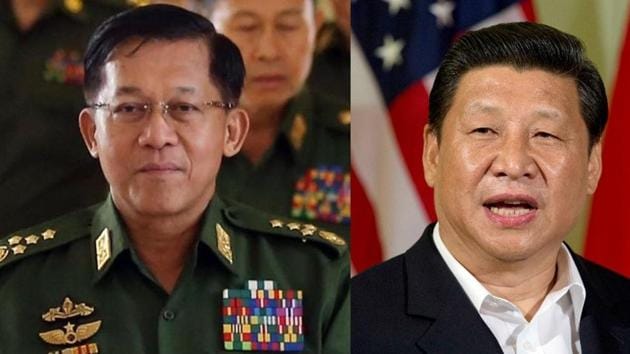
The reference to ‘strong forces’ was widely seen to be a reference to Myanmar’s neighbour in the north, China.
Myanmar military spokesperson Brigadier General Zaw Min Tun later elaborated on the comment made by the Commander-in-Chief of Myanmar’s armed forces. The spokesperson said the army chief was referring to Arakan Army (AA) and Arakan Rohingya Salvation Army (ARSA), terrorist organisations active in the Rakhine State in western Myanmar that borders China.
A ‘foreign country’ is behind the Arakan Army (AA), he said, citing China-made weapons that terror group used in mine attacks on the military in 2019.
It is unusual for the Myanmar leadership to point fingers at China. But this isn’t the first time that Naypyitaw had alluded to the Chinese connection.
When the Myanmar military busted a huge cache of weapons including surface-to-air missiles - each costing between USD 70,000 and 90,000 - from the banned Ta’ang National Liberation Army in November 2019, the military had underlined the Chinese connection to the weapons. Most of the weapons seized by the force are “Chinese weapons,” military spokesperson Major General Tun Tun Nyi had declared.
{{/usCountry}}When the Myanmar military busted a huge cache of weapons including surface-to-air missiles - each costing between USD 70,000 and 90,000 - from the banned Ta’ang National Liberation Army in November 2019, the military had underlined the Chinese connection to the weapons. Most of the weapons seized by the force are “Chinese weapons,” military spokesperson Major General Tun Tun Nyi had declared.
{{/usCountry}}The Myanmarese ethnic rebel groups operating along the Chinese border mostly use Chinese weapons, prompting suspicions about Beijing’s role as part of an effort to keep Myanmar under control
China, for the record, denies that it supplies weapons to armed rebel groups in Myanmar but such denials are often treated with scepticism in Myanmar.
Senior General Hlaing had flagged Myanmar’s concerns around these weapons when he hosted Chinese President Xi Jinping in January this year. Xi then promised that China would “carefully scrutinise” matters and “solve the problem”, pointing that there were other ways for the rebels to acquire Chinese weapons.
Xi’s suggestion was seen in Myanmar as part of an elaborate exercise by China to keep its smaller neighbour “unstable”. There has been a view in Naypyitaw that China was using its influence with the terror groups as a bargaining chip for smooth implementation of Belt and Road Initiative projects.
Officials say Beijing has been desperate to push the China-Myanmar Economic Corridor that seeks to give China a strategic opening on to the Bay of Bengal and eastern part of Indian Ocean Region. There has also been some concern around the Chinese loans extended to execute these projects that led to worries that Myanmar shouldn’t land in China’s debt trap.