
 E-Paper


Follow the latest breaking news, major developments and agenda-setting stories from India and around the world with the newsdesk at Hindustan Times. Operating round the clock, the desk brings together experienced editors, reporters and correspondents to deliver fast, accurate and contextual reporting across subjects that influence public policy, governance, business, society and international affairs. The HT News Desk covers politics, elections, government policies, the economy, business and markets, science and technology, the environment, law and order, infrastructure, education, climate issues and geopolitics, while closely tracking developments across states, institutions and global capitals. The team also leads coverage of major breaking news events, policy announcements, court proceedings, natural disasters, public emergencies and significant international developments. Reports published by the newsdesk are based on information gathered from reporters on the ground, official statements, government agencies, court records, regulatory filings, recognised institutions and other authoritative sources. Stories undergo editorial scrutiny and verification processes to ensure accuracy, fairness and relevance, and are updated as events evolve and additional information becomes available. Whether covering a key political decision in New Delhi, an economic policy shift affecting millions, a landmark court ruling or a major global event, the HT News Desk aims to provide readers with reliable, fact-based journalism that delivers not only the latest developments but also the context and analysis needed to understand their wider implications.
 Trending News
Thousands flee in expectation of Myanmar military operation
The exodus from more than 40 villages is continuing almost a week later, even though the order was revoked last Friday Rakhine state’s security and border affairs minister.


Thousands of people in an area of western Myanmar where there have been clashes between the government and ethnic rebels have been fleeing from their villages over the past week after an evacuation order from officials.
The Rakhine state government in an order last Tuesday instructed village administrators in Rathedaung township to tell residents to stay away from their homes due to military plans to conduct a “clearance operation” against the rebels. “Clearance operation” is Myanmar military parlance for counter insurgency action.
The exodus from more than 40 villages is continuing almost a week later, even though the order was revoked last Friday Rakhine state’s security and border affairs minister.
“Since the day the order was issued, more than 10,000 people from the operation area fled their villages,” Khin Maung Latt, an upper house member of parliament for Rathedaung township, said Monday.
The government has been embroiled for more than a year in an intermittent conflict with the Arakan Army, a well-trained and well-armed guerrilla force representing members of the area’s Rakhine ethnic group.
The guerrilla force is posing the strongest military challenge to the central government of the many ethnic minority groups who for decades have sought greater autonomy.
Human rights advocates have accused Myanmar’s army of using undue force and targeting civilians in their operations fighting the guerrillas.
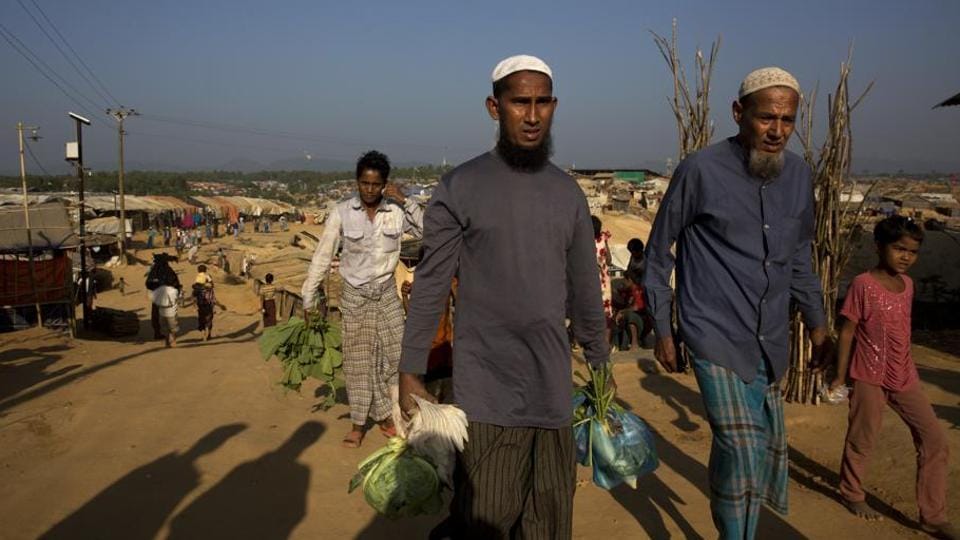
In Rakhine in 2017, the military carried out counter insurgency operations against insurgents from the Muslim Rohingya minority, but critics charge they employed a campaign of terror to drive the Rohingya out of the country. An estimated 740,000 Rohingya fled to neighbouring Bangladesh, where they remain in refugee camps.
The Rakhine are Buddhist, the religion of almost 90% of Myanmar’s people.
During the past week’s exodus, some people fled to villages out of the designated area, and others to Sittwe, the capital of Rakhine.
“We have to flee the village as we don’t want to face the soldiers from the military. They were shooting into the village, arresting the villagers to use as human shields,” said Aye Mg, a 58-year-old resident of Rathedaung township’s Kyauktan village, where the government previously detained dozens of suspected Rakhine militants.
Civil society organizations and Buddhist monks are helping the newly displaced villagers find shelter.
“People can’t live in their places any longer due to the fighting. We are hosting over 300 displaced people at our monastery; around 100 of them have arrived recently,” Okkahta, a monk, said from the Tahtipati Sipintharyar Monastery in Rathedaung town.
“It’s like doomsday for them,” lawmaker Khin Maung Lat said, explaining why villagers fled. “They are in fear. This is the impact of the evacuation order to stay away from the village during the military operation.”
“Even most of the village administrators are fleeing from the villages,” he said. “Even they are scared to go back to their villages.”


