E-Paper



Nipah outbreak in Kerala: Experts suspect human-to-human transmission
A team from the National Centre for Disease Control (NCDC) is also in Kerala to investigate the source of transmission after NIV confirmed three deaths on Sunday.

 Prefer HTon Google


Epidemiologists and virologists are investigating whether the outbreak in Kerala of Nipah, a zoonotic disease that is usually transmitted to humans from fruit bats, could be the result of human-to- human transmission.
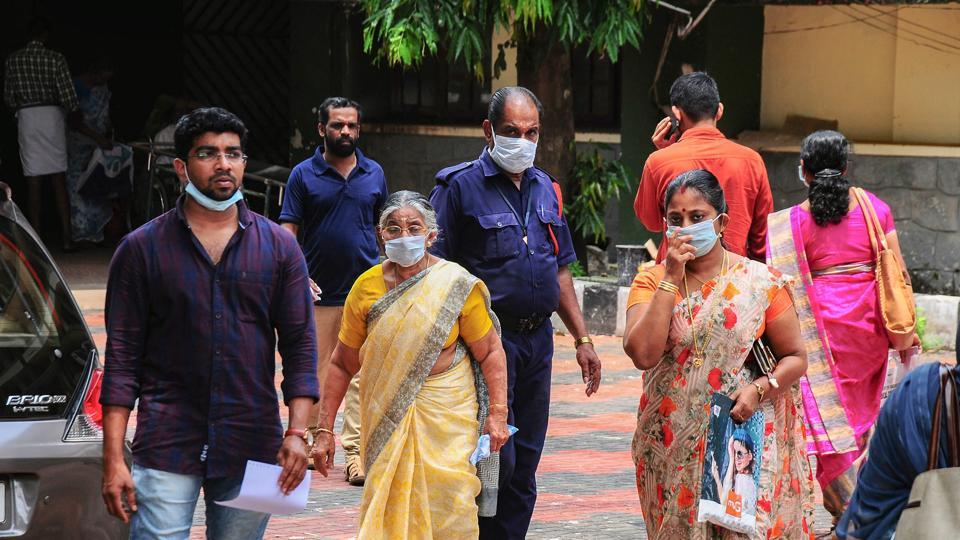
“It could be a case of human-to-human transmission but it is too early to confirm that as our expert team has just reached the spot, and will take about a day or two to submit its report,” said Preeti Sudan, Union health secretary, who is getting regular updates of the situation.
“We have sent samples for checking to the National Institute of Virology (NIV) in Pune and expect the results to help us understand better the exact nature of transmission,” said Sudan.
A team from the National Centre for Disease Control (NCDC) is also in Kerala to investigate the source of transmission after NIV confirmed three deaths on Sunday.
“Our initial investigation says people have died due to respiratory distress syndrome that damaged their lungs. We are conducting a detailed investigation and should know soon what exactly the situation is on ground,” said Dr Promila Gupta, director general health services (DGHS).
“Whether it was a single source infection or one of the three dead got infected and infected others is difficult to tell and needs to be investigated. Our focus will be to find out the source of spread,” said a team member, requesting anonymity as he is not authorised to speak to the media.
Doctors at a the Amrita Institute of Medical Sciences (AIMS) in Kochi, where two persons — a 19-year-old woman and 1.5-year-old child— are admitted, also suspect suspect human-to-human transmission as both had contact with the three dead where Nipah has been confirmed by NIV.
“The woman’s fiancée has died of Nipah so she has a history of close contact and the child suffers from a congenital heart defect because of which he was admitted in the same hospital ward as one of the dead . The reports for both so far are negative but as the incubation period is 18 days, we might send samples for repeat testing,” said Dr Sanjeev Singh, medical director, AIMS, Kochi.
The woman had symptoms of fever and cough along with headache, nausea and tiredness. Her fiancé and his brother are among the confirmed Nipah deaths.
She is being managed with strict contact isolation in an isolation ward even though her symptoms are gone , say doctors treating her.
“There appears to be human-to-human transmission as the high infection rate suggests. It is unlikely that so many people will eat the same food or drink same water,” added Dr Singh.