Bihar chief minister Nitish Kumar's Janata Dal (United) has joined key Bharatiya Janata Party (BJP) allies in expressing concerns over the government's Waqf (Amendment) Bill, a stance previously taken by Chirag Paswan's Lok Janshakti Party (Ram Vilas) and Andhra Pradesh's Telugu Desam Party led by Chandrababu Naidu.
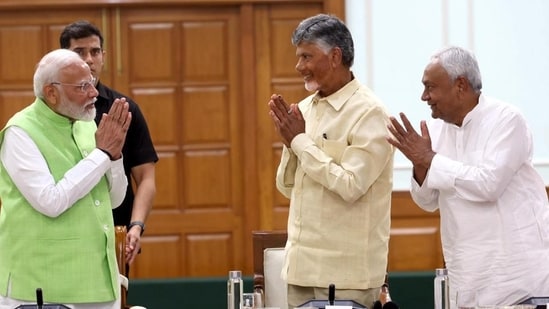
The JD(U) is pushing for changes to the proposed law to better protect the interests of the Muslim community, which makes up 18 percent of the population in the state facing an assembly election next year, NDTV reported.
The party had initially backed the Bill earlier this month and its MP Rajiv Ranjan even supported the legislation during a Lok Sabha debate. He had termed the amendments as essential for enhancing transparency.
However, dissent has emerged within the JD(U) as Bihar minority welfare minister Mohammad Zama Khan expressed concerns about certain provisions to the chief minister, the report said.
Not only has Khan raised concerns, but water resources minister Vijay Kumar Choudhary has also expressed apprehensions about the impact on the Muslim community.
Why has the Waqf Bill been referred to a 21-member Joint Parliamentary Committee?
The Lok Sabha on August 9 set up a 21-member Joint Parliamentary Committee (JPC) to examine the contentious Waqf (Amendment) Bill, 2024, which will submit its report by the end of the first week when Parliament convenes next.
{{/usCountry}}The Lok Sabha on August 9 set up a 21-member Joint Parliamentary Committee (JPC) to examine the contentious Waqf (Amendment) Bill, 2024, which will submit its report by the end of the first week when Parliament convenes next.
{{/usCountry}}The motion for the JPC was moved by Union minister of parliamentary affairs and minority affairs Kiren Rijiju. The Bill, introduced by Rijiju in Lok Sabha on August 8 , seeks to bring changes to the powers of state Waqf boards, survey of Waqf properties and removal of encroachments by amending the Waqf Act, 1995.
A waqf is a Muslim religious endowment, usually in the form of landed property, made for purposes of charity and community welfare. Rijiju also introduced the Mussalman Wakf (Repeal) Bill, 2024, which seeks to repeal the Mussalman Wakf Act, 1923.
The Opposition accused the government of violating the right to freedom of religion. Samajwadi Party chief Akhilesh Yadav said the bill was being introduced to appease the Bharatiya Janata Party’s hardcore supporters.
The most controversial provision is a proposal to induct non-Muslims in the central waqf council, state waqf boards, and waqf tribunals, calling for such bodies to become “more broad-based,” with representation of Shia, Sunni, Bohra, Agakhani, and other Muslim sects, along with non-Muslims.