The national capital witnessed the unfettered use of firecrackers across the city on Diwali, but the city was spared the toxic aftermath of flagrant violations as strong winds washed away much of the pollutants that choked the city’s air on Monday evening.
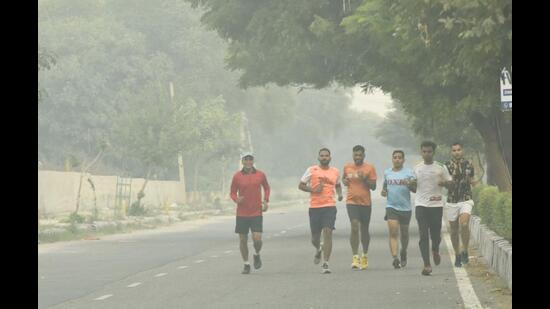
The air quality index (AQI) reading was marginally better on the day after Diwali — a first since the system was started in 2015 — dropping from 312 on Monday to 303 on Tuesday. But experts pinned this unusual improvement on the consistently strong winds that blew in from the west throughout Monday evening , and a sunny Tuesday that raised the ground temperature enough to disperse pollutants.
Were it not for the conditions, they added, Delhi’s air quality may have aggravated to hazardous levels, thanks to citywide violations of the ban on firecrackers, which cloaked the city in a pall of smog, as rockets, anaars (flowerpots), chakhris (ground spinners), rockets, phuljadi (sparklers) and ladis (bomb garlands) went off lanes and bylanes, with police turning a deaf ear and blind eye.
The sounds of crackers reverberated all evening, and late into the night — with little in the way of police action, despite the Delhi government earlier warning residents of up to a six-month prison stint if they were found violating the blanket ban, which was imposed in early-September to avoid a rerun of the city’s annual post-Diwali air emergency.
{{/usCountry}}The sounds of crackers reverberated all evening, and late into the night — with little in the way of police action, despite the Delhi government earlier warning residents of up to a six-month prison stint if they were found violating the blanket ban, which was imposed in early-September to avoid a rerun of the city’s annual post-Diwali air emergency.
{{/usCountry}}Delhi Police spokespersons did not respond to requests seeking comment on the lax imposition of the ban, nor did they reveal specific data on arrests made or FIRs filed on Diwali day for the use of firecrackers. Delhi Police does not come under the Delhi government, and reports to the Union government.
A three-day spell of late monsoon rain in the first week of October delayed farm fires in Punjab and Haryana, said experts, adding that this, coupled with an early Diwali (which is often celebrated in November), together laid the ground for lower-than-usual pollution.
“While the AQI has been fairly low this year, this is mostly down to an early Diwali, rains in early October and favourable meteorological factors. Good wind speed, which continued even on Tuesday, has controlled the spike in pollution generally seen after every Diwali. Farm fire numbers are also fairly low at the moment and this peak may come next month now,” said Anumita Roychowdhury, executive director, research and advocacy at the Centre for Science and Environment (CSE).
Reacting to the relatively clean air, Delhi chief minister Arvind Kejriwal on Tuesday tweeted that the Capital was “working hard” to fix its air pollution problem.
“There have been very encouraging results but there is still a long way to go. We will make Delhi the best city in the world,” he tweeted.
This was the first time Delhi’s pollution levels fell the day after Diwali, according to the Central Pollution Control Board’s (CPCB) AQI system, which has been in place since 2015.
Last year, the AQI spiked from 382 on Diwali day (November 4) to 462 (severe) the day after that. In 2020, it went from 414 on Diwali to 435.
However, Delhi’s AQI on Diwali day itself was also the second-lowest ever, beaten by a reading of 281 on November 7, 2018. That year, pollution levels jumped to 390 the next day.
The Delhi Pollution Control Committee (DPCC) in its Diwali analysis said the concentration of PM2.5 in the city’s air fell 64% this Diwali, compared to last year, and PM10 levels dipped 57%.
“The AQI has meanwhile observed a 30% drop this Diwali as compared to last year. All stations in Delhi also recorded a fall in the PM2.5 and PM10 concentration as compared to last year,” said DPCC on Tuesday.
DPCC data showed that pollution levels, in terms of PM2.5, peaked at Delhi’s Okhla Phase 2, where levels of the pollutants touched an hourly average of 1,042 micrograms per cubic metre at midnight — nearly 17 times the national daily safe limit. This was followed by Pusa, which hit an hourly peak of 990 micrograms per cubic metre at midnight.
Karol Bagh was the noisiest part of the city on Diwali evening, DPCC said in its report, with an average reading of 82db(A), well beyond the 55db(A) limit allowed in residential areas, indicating that cracker ban violations were likely even more rampant in the central Delhi neighbourhoods than others. Jahangirpuri (81.8db(A)) in north-west Delhi and Patparganj (81.5) were the second and third most noisy areas in the city on Diwali, said the report.
To be sure, while there is no way to quantify if the use of firecrackers fell compared to last year or not, the Delhi government estimated that use dipped 30%. Further, firecrackers weren’t freely available in Delhi thanks to the ban, which choked supplies of the contraband and forced sellers to clandestinely peddle their contribution, or for people to travel to other NCR cities to make purchases.
Evidence from other Indian cities that had curbs on the use of firecrackers seems to suggest that bans and restrictions do have a tangible positive impact on the air. Such cities had a lower deterioration in AQI the day after Diwali as compared to those that no curbs on the use of firecrackers.
For instance, in Patna, which had a complete ban on crackers, the AQI increased only marginally, from 153 on Diwali to 172 the next day.
In Jaipur, where the use of so-called “green” crackers was allowed between 8pm and 10pm, AQI jumped from 130 to 262. Lucknow, which had no curbs on firecracker use, saw its AQI leap from 137 to 246.
According to the Early Warning System (EWS), which the Commission for Air Quality Management (CAQM) uses to take pre-emptive action on the Graded Response Action Plan (Grap), the AQI for the next three days in Delhi is likely to remain in the lower end of the “very poor” category, and is expected to hover between “poor” and “very poor” in the subsequent six days.