The Supreme Court has ordered an immediate stop on all commercial activities in a 500-metre radius of the iconic Taj Mahal, and asked the Agra Development Authority to ensure compliance of its directive.
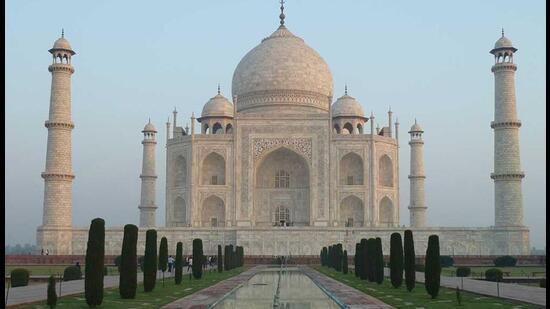
In an order released on Monday, the top court allowed a plea which had sought a directive to the authorities concerned for prohibiting commercial activities in the 500-meter periphery of the 17th century monument.
“We allow the prayer that reads — Direct the Agra Development Authority to remove all business activities within 500 meters from the boundary/peripheral wall of the monument Taj Mahal which shall be in tune with Article 14 of the Constitution of India,” stated the bench of justices Sanjay Kishan Kaul and AS Oka.
The bench took on record the submissions of senior advocate ADN Rao, who is assisting the court as an amicus curiae, that it would be in the interest of the protected monument to issue directions for barring all commercial activities near the Taj Mahal. Rao pointed out that the top court had issued a similar order in May 2000 but it is only appropriate to reiterate the direction in view of the long passage of time.
The bench agreed with the senior counsel and directed the Agra Development Authority to immediately clear the 500-metre radius of the Taj Mahal of all commercial activities.
{{/usCountry}}The bench agreed with the senior counsel and directed the Agra Development Authority to immediately clear the 500-metre radius of the Taj Mahal of all commercial activities.
{{/usCountry}}The order came on an application by a group of shop owners, who have been allotted space outside the 500-metre radius. Representing the applicant, advocate MC Dhingra complained of gross violation of the previous court order near the western gate of the monument as illegal business activities thrived. Dhingra urged the bench to issue appropriate orders for stopping the activities and making the authorities liable for compliance.
Following a public interest litigation by environmentalist MC Mehta in 1984, the apex court has been monitoring developments in the area to protect the Taj Mahal, built by Mughal emperor Shah Jahan in the memory of his wife Mumtaz Mahal in 1631. The mausoleum is also a UNESCO World Heritage Site.
Under the orders of the Supreme Court, a Taj Trapezium Zone (TTZ) has been earmarked, which is an area of about 10,400 sq kms spread over the districts of Agra, Firozabad, Mathura, Hathras and Etah in Uttar Pradesh and Bharatpur in Rajasthan, to protect the monument from environmental pollution.
The TTZ Pollution (prevention and control) Authority was also set up to monitor the progress of implementation of various schemes for protection of the Taj Mahal and programmes for improvement of the environment in TTZ.
The 500-metre radius of the monument is a no-construction zone, besides has strict regulations on vehicular movement and a ban on burning of wood, municipal solid waste and agriculture waste.