There is no report of deaths due to manual scavenging but 161 people died in accidents while undertaking cleaning of sewers and septic tanks in the last three years, the Centre said on Wednesday.
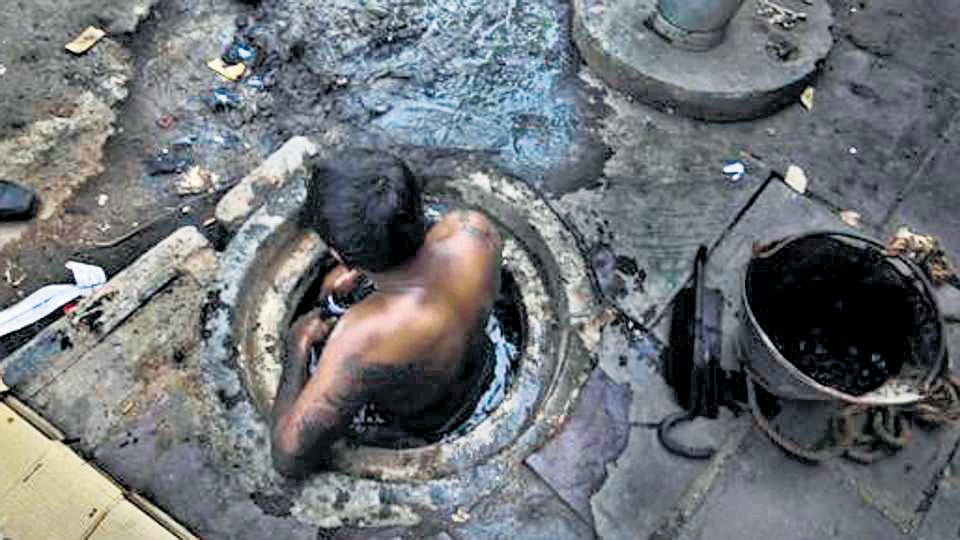
“There is no report of deaths due to manual scavenging. However, 161 persons have died due to accidents while undertaking hazardous cleaning of sewer and septic tanks during the last three years,” Union minister of social justice and empowerment Virendra Kumar said in a written statement in the Rajya Sabha.
Tamil Nadu reported the highest number of such deaths at 27, followed by Uttar Pradesh with 26 , he added.
Kumar’s statement was in response to a query by Bharatiya Janata Party (BJP) MP Mahesh Podda who sought to know how many manual scavengers had died in the last three years.
Manual scavenging is banned under the Prohibition of Employment As Manual Scavengers and Their Rehabilitation Act, 2013. The government has differentiated between deaths due to manual scavenging and those that have occurred while cleaning sewers. Experts have maintained that cleaning sewers and septic tanks is a mere extension of the now-banned practice of manual scavenging or the cleaning of human excreta by hand.
The minister told the Upper House that 58,098 manual scavengers were identified across the country in two separate surveys in 2013 and 2018. All of them were provided with one-time cash assistance of ₹40,000 under the Scheme for Rehabilitation of Manual Scavengers (SRMS), he said.
{{/usCountry}}The minister told the Upper House that 58,098 manual scavengers were identified across the country in two separate surveys in 2013 and 2018. All of them were provided with one-time cash assistance of ₹40,000 under the Scheme for Rehabilitation of Manual Scavengers (SRMS), he said.
{{/usCountry}}Uttar Pradesh has the highest number of manual scavengers, he added.
The ministry had launched a mobile app – Swachchata Abhiyaan – in 2020 to identify and geotag the data of insanitary latrines and manual scavengers. “Not a single insanitary latrine has been confirmed so far,” Kumar said.
Reacting to the government’s statement, Bezwada Wilson, founder of Safai Karmachari Andolan which aims to eradicate manual scavenging from the country, said: “The practice of cleaning dry latrines is very prevalent in Uttar Pradesh, Madhya Pradesh, Bihar and Jammu & Kashmir. We have evidence for this and each time we try to share the same, the safai karmachaaris are harassed by the government and police… in such circumstances, people may not come and openly give a statement.”