
Sign in

No money in Indian budget for Chabahar port project in Iran amid US threats: What it means

India earlier made annual outlay of 100 crore for project in Sistan-Balochistan province on Iran's coast

Published on: Feb 1, 2026, 15:43:34 IST
Written by
Share
Share via
  • facebook
  • twitter
  • linkedin
  • whatsapp
Copy link
  • copy link

In a departure from the past and an ominous sign for the project's future, the Indian government did not allocate any funds for the Chabahar port in Iran amid US sanctions on the Islamic Republic.
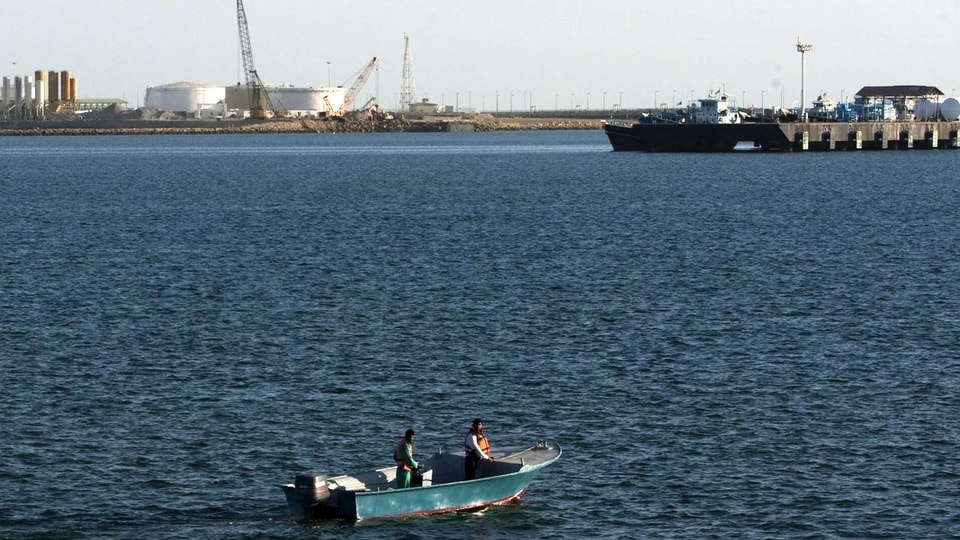
US sanctions on Iran affect India's Chabahar project despite a temporary waiver for it until April 2026. (Reuters File Photo)

In the last few years, India has been making an annual outlay of 100 crore to the project in the Sistan-Balochistan province on Iran's southern coast, being a major partner in the development of the port.

US sanctions on Iran affect India's Chabahar project despite a temporary waiver for it until April 2026.

As of now, India has not officially pulled out of the Chabahar project, but this pause in funding comes also amid tightened US sanctions and massive tariffs on India. Half of the 50% tariffs on India already are for its oil trade with Russia despite the Ukraine war, Donald Trump has said. The US President wants India to cut its trade with Iran too.

It is learnt that India was mulling various options relating to the project after Trump administration threatened a 25% additional tariff on countries doing business with Tehran, news agency PTI has reported.

There have been reports that India has pulled out altogether and transferred its full committed amount of $120 million to the Iranian side, the last tranche being in August 2025. India has not confirmed this, and is learnt to be managing the project through local Iranian staff to avoid violating US rules, Reuters has reported.

The 2024 10-year deal to operate the port is a strategic, though constrained, investment for India.

The long-term India-Iran agreement for the Shahid Beheshti Terminal at Chabahar was signed on May 13, 2024. This contract, signed in Tehran by India Ports Global Limited (IPGL) and Iran's Ports and Maritime Organisation (PMO), replaced earlier, shorter-term agreements.

It got complicated as the US imposed crippling economic sanctions on Iran in September, though it granted India a six-month exemption that ends in April.

Last month, India's foreign ministry spokesperson Randhir Jaiswal said India is engaged with the US on the issue related to the Chabahar port project.

Both India and Iran have been strongly pitching for Chabahar port as an integral part of the International North-South Transport Corridor (INSTC).

The INSTC is a 7,200-km-long multi-mode transport project for moving freight among India, Iran, Afghanistan, Armenia, Azerbaijan, Russia, Central Asia and Europe.

  • Aarish Chhabra
    ABOUT THE AUTHOR
    Aarish Chhabra

    Aarish Chhabra is an Associate Editor with the Hindustan Times online team, writing news reports and explanatory articles, besides overseeing coverage for the website. His career spans nearly two decades across India's most respected newsrooms in print, digital, and broadcast. He has reported, written, and edited across formats — from breaking news and live election coverage, to analytical long-reads and cultural commentary — building a body of work that reflects both editorial rigour and a deep curiosity about the society he writes for. Aarish studied English literature, sociology and history, besides journalism, at Panjab University, Chandigarh, and started his career in that city, eventually moving to Delhi. He is also the author of ‘The Big Small Town: How Life Looks from Chandigarh’, a collection of critical essays originally serialised as a weekly column in the Hindustan Times, examining the culture and politics of a city that is far more than its famous architecture — and, in doing so, holding up a mirror to modern India. In stints at the BBC, The Indian Express, NDTV, and Jagran New Media, he worked across formats and languages; mainly English, also Hindi and Punjabi. He was part of the crack team for the BBC Explainer project replicated across the world by the broadcaster. At Jagran, he developed editorial guides and trained journalists on integrity and content quality. He has also worked at the intersection of journalism and education. At the Indian School of Business (ISB), Hyderabad, he developed a website that simplified academic research in management. At Bennett University's Times School of Media in Noida, he taught students the craft of digital journalism: from newsgathering and writing, to social media strategy and video storytelling. Having moved from a small town to a bigger town to a mega city for education and work, his intellectual passions lie at the intersection of society, politics, and popular culture — a perspective that informs both his writing and his view of the world. When not working, he is constantly reading long-form journalism or watching brainrot content, sometimes both at the same time.Read More

Get the latest India News, breaking headlines and real-time updates from across the country. Stay informed about politics, government policies, crime, weather and major national developments.