Former Army chief Manoj Mukund Naravane drew a comparison between the twin challenges of China and Pakistan that India faces on its borders. Naravane described China as India's "main competitor" in the years to come , while he said that Pakistan will continue to remain a key security challenge due to its support for terrorism.
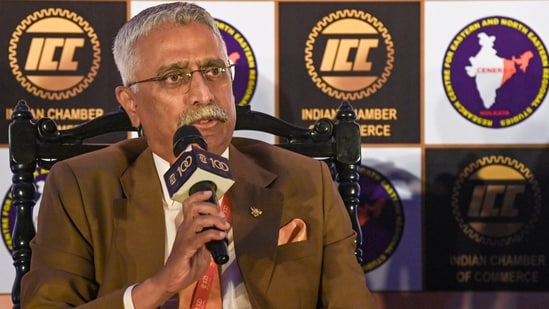
Naravane made the remarks at the launch of his book The Curious and the Classified: Unearthing Myths and Mysteries in Pune on Friday. The former Army chief said India must distinguish between a competitor and an enemy, as he emphasised the need to resolve differences with China through dialogue while maintaining strong military deterrence.
"Pakistan and China are a totally different ballgame. We have fought wars with both of them. We have unsettled borders. So, they will always remain on our radar as a threat, as a challenge," Naravane was quoted as saying by news agency ANI.
On how India should deal with the two challenges, Naravane said the relative importance and priority accorded to the two would keep changing depending on the evolving situation.
"Because we have fought major wars with Pakistan and because of their continued support to terrorism, our attention is towards our western borders. But that attention towards the western borders is because of the terrorism angle," he was quoted as saying.
{{/usCountry}}"Because we have fought major wars with Pakistan and because of their continued support to terrorism, our attention is towards our western borders. But that attention towards the western borders is because of the terrorism angle," he was quoted as saying.
{{/usCountry}}"That's the short-term aim and objective. I think we are very clear that in the long term and in the years to come, China is going to be our main competitor. And I purposely use the word competitor and not enemy," the former Army chief said.
‘China will compete with India’
He said that China would compete with India in multiple domains – political, economic, trade and military.
"Because they are going to be our main competitor in all fields. Political, economic, trade and of course military also. And wherever there is competition, there is always a little bit of conflict," he was quoted as saying.
Naravane stressed that India should seek to resolve such differences through talks and dialogue, with the use of force being the last resort.
"But it is up to us to try to resolve those conflicts, those differences through the mechanisms of talks, dialogues. And taking recourse to the use of force should always be the last resort. We should try our best to resolve disputes through dialogue," he said.
However, he maintained that a credible military deterrence is important.
"You have to have a strong deterrence to stop anybody from resorting to the use of force or any misadventure. And that is why the saying is there that if you want peace, prepare for war," Naravane said.
He also made remarks on situation in Pakistan and said that is for them to look into the internal matters.
"I think what is happening in Pakistan is for them to look at our policy of not interfering in the internal matters of neighbouring countries. Just as we don't like others interfering in our internal matters, I think we reciprocate by not interfering in the internal affairs of others," Naravane noted.
‘PoK an integral part of India’
On Pakistan-occupied Kashmir, he referred to India's parliamentary position and said the country's claim over the territory remains open-ended.
"As far as POK is concerned, there is a parliamentary resolution of sometime in the 80s, which says that POK is an integral part of the Union of India," he said.
He clarified that India's claim on POK did not necessarily imply the use of military force to capture the territory.
"It's not that it will be done by force of arms or forcefully; we will attack and capture POK. So, it is an open-ended resolution that we don't give up our claim on Pakistan-occupied Kashmir. That is part of the map of India, as we know it," he said.
On the question of the population in POK in the event of any future amalgamation, Naravane cited India's experience in the Northeast and said winning the confidence of people was a long-term process.
"As far as the populations are concerned, that will be, of course, a matter of concern. But it is up to us, just as we have won over the populations in our border states. Northeast was all insurgency," he said.